How to Teach Dog Intersection Behavior Safely
A Manhattan intersection can change in a second: a delivery bike cuts through the light, a bus exhales at the curb, another dog appears across the street, and your dog suddenly wants to move. Knowing how to teach dog intersection behavior gives your pup a clear job in those busy moments. It is not about making them perfectly still for every block. It is about building a calm, repeatable routine that keeps them connected to you until it is safe to cross.
For city dogs, intersection manners are a safety skill as much as a leash skill. A dog who understands that the curb means “pause, check in, wait” is less likely to drag you into traffic, bolt after a pigeon, or become overwhelmed by the movement around them. The goal is a dog who can move through the city with confidence, not a dog who feels corrected at every corner.
What Good Intersection Behavior Looks Like
Before training, decide what you want your dog to do at each corner. The routine should be simple enough that you can use it on a rushed morning or in the rain, and consistent enough that your dog can predict it.
At minimum, your dog should approach the curb on a manageable leash, stop before stepping into the street, and wait for your release cue before moving forward. Many dogs also learn to look at their person at the curb. That check-in is helpful, but it does not need to be a long, formal stare. A quick glance that says, “What are we doing next?” is plenty.
Some dogs do well with a sit at every intersection. Others, especially older dogs, large dogs, anxious dogs, or dogs wearing a backpack or coat, are more comfortable standing quietly. Do not force a sit just because it looks tidy. A steady stand with a loose leash is safe, practical, and often easier to maintain on crowded Manhattan sidewalks.
Start With the Skills Away From Traffic
The street corner is not the best classroom for a brand-new cue. Begin in a quiet hallway, building lobby, courtyard, or calm stretch of sidewalk where your dog can think without buses, scooters, and pedestrians competing for their attention.
Choose three clear cues: a cue to slow or stop, a waiting cue, and a release cue. Your words can be “stop,” “wait,” and “let’s go,” but the exact language matters less than using it consistently. Avoid using “okay” as a release if it comes up frequently in everyday conversation. Your dog deserves a cue that is easy to recognize.
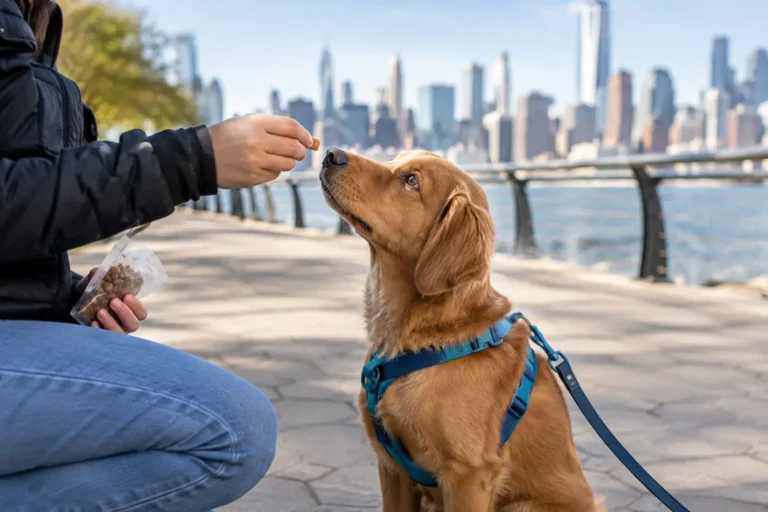
Walk a few steps, stop, and reward your dog when they stop with you. At first, you may reward the moment their feet pause. Then gradually wait for a second or two of stillness before offering praise and a small treat. Give your release cue, take a few steps forward together, and repeat.
Keep these early sessions short and cheerful. Five successful repetitions are more useful than twenty repetitions after your dog has lost interest. The point is to teach the pattern: stopping beside you makes good things happen, and moving forward happens only after you say so.
Build a Reliable Check-In
Once your dog understands the stop-and-wait pattern, add a check-in. When you stop, quietly say their name once. The instant they look toward you, mark it with warm praise such as “yes” and reward. If your dog already knows a hand target, you can hold your hand near your leg so they have an easy, familiar place to focus.
Do not repeat their name over and over. If they cannot look at you, the environment is probably too difficult right now. Create distance from the distraction, use a higher-value treat, or return to an easier location. Training works best when your dog can succeed before they are already overstimulated.
How to Teach Dog Intersection Behavior on Real Walks
When your dog is consistently stopping and waiting in quiet places, bring the routine to a low-traffic intersection. Choose a time when the sidewalk is less crowded, and give yourself extra time. This is practice, not a test.
As you approach the curb, shorten the leash enough to maintain control without pulling your dog tight against you. Say your stop cue before you reach the edge, then stop several feet back from the curb if that gives you more room. Reward your dog for stopping with you. Ask for a brief check-in if they are ready for it, then wait for the pedestrian signal and scan the street yourself.
Your dog should not be deciding when to cross based on the signal or the movement of people around you. Even a dog who understands the routine needs your release cue. When the path is clear and the crossing signal allows it, say “let’s go” and walk forward at a steady pace. Reward your dog after you have crossed, especially in the beginning.
That reward placement matters. Offering a treat at the curb can be useful while teaching the pause, but feeding after the crossing reinforces the full sequence: stop, wait, cross with your person. For food-motivated dogs, a small treat is often enough. For dogs who prefer praise, a happy voice and permission to sniff at the next safe spot may be just as valuable.
Manage the City Distractions You Cannot Control
New York City does not offer perfect training conditions. Horns, construction, pigeons, joggers, food smells, and off-leash surprises can show up without warning. Your job is not to prove that your dog can handle every distraction at once. Your job is to make safe choices before they go over threshold.
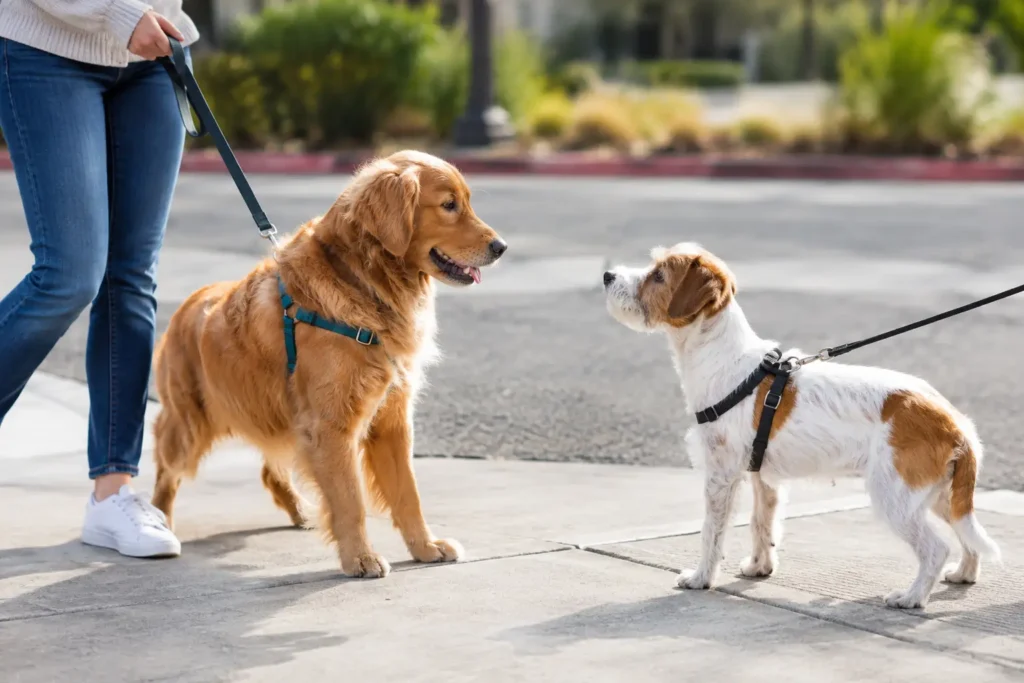
If your dog sees another dog across the street and begins leaning, barking, or pulling, skip the training repetition. Turn away, increase distance, and help them settle. Waiting at a crowded corner while your dog becomes more upset rarely teaches calmness. It teaches them that intersections are stressful.
For dogs that lunge toward moving objects, use extra space near the curb and avoid standing directly beside bike lanes whenever possible. Keep your leash hand secure, but do not wrap the leash around your wrist. A sudden pull can injure both of you. A well-fitted harness and a standard fixed-length leash usually offer more control and clearer communication than retractable equipment in dense pedestrian areas.
Puppies need especially short, positive practice. Their attention may last only a few seconds, and that is normal. Reward them for noticing the curb, stopping with you, and taking one calm crossing. With reactive or fearful dogs, progress may begin even farther from the intersection. Watching traffic from a comfortable distance, receiving treats, and leaving before stress rises is real training.
Common Mistakes That Slow Progress
The most common mistake is asking too much too soon. A dog may wait beautifully in the lobby and struggle outside a busy subway entrance. That does not mean they are being stubborn. It means the distraction level changed faster than their skills could keep up.
Another mistake is using leash pressure as the main lesson. A quick safety intervention may be necessary if a dog steps toward the street, but repeated pulling can make the curb feel confusing or unpleasant. Whenever possible, teach the behavior before you need it: slow down, stop together, reward the pause, then release.
Inconsistent releases can also blur the lesson. If your dog sometimes crosses when other people move, sometimes crosses on a green light, and sometimes crosses only after hearing “let’s go,” they will naturally choose the rule that seems most rewarding in the moment. Make your release cue the one dependable green light.
Finally, remember that behavior can change with a dog’s energy level, health, and surroundings. A dog who handles a calm Sunday morning may need more support during weekday rush hour. Adjusting the walk is good handling, not a setback.
When One-on-One Support Helps
If intersections bring out intense pulling, freezing, lunging, or panic, personalized leash training can make a meaningful difference. A skilled handler can observe what happens before the behavior escalates, adjust pace and distance, and help create cues that fit your dog rather than forcing a one-size-fits-all method.
At Pet Love NYC, our one-on-one walks and leash training approach are built for the real conditions Manhattan dogs face. We focus on clear communication, individualized pacing, and safety-first handling, while keeping you informed about what your dog is practicing and how they are progressing.
Every calm pause at the curb is a small moment of trust. Practice it patiently, celebrate the wins, and give your dog the love and attention they need to feel safe walking beside you.