


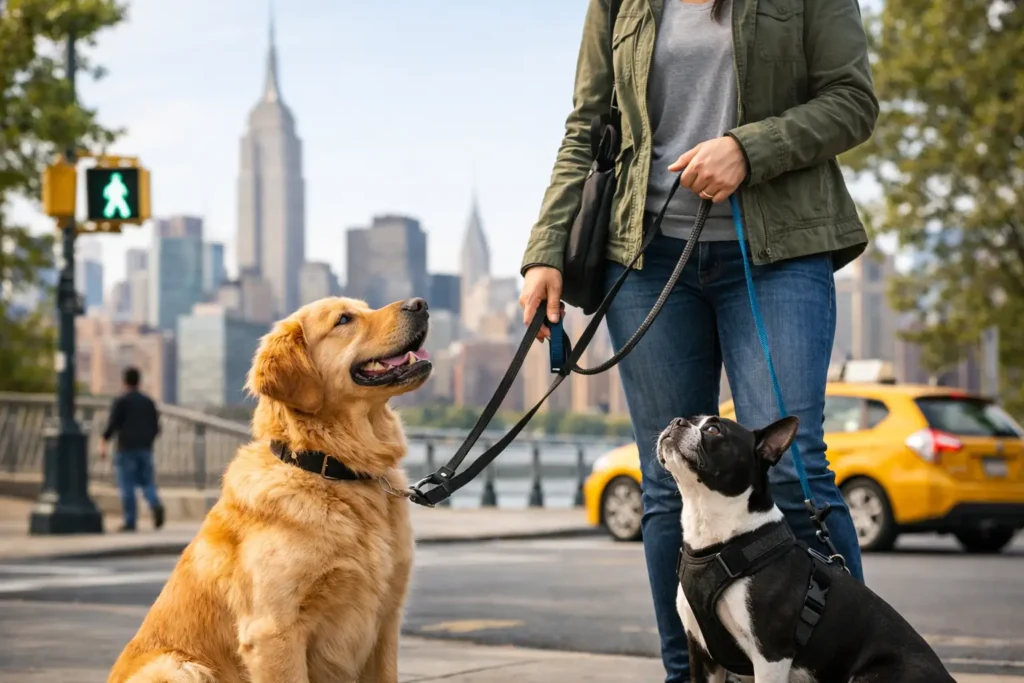
The moment your dog sees a pigeon, a delivery cart, or another dog across the avenue, a peaceful walk can turn into a full-body tug-of-war. So, can dog walkers help leash manners? Yes – when walks are consistent, individualized, and handled with the same calm expectations every time. For Manhattan dogs, better leash behavior is not about a perfect heel. It is about moving through a busy neighborhood safely, comfortably, and with more confidence.
A skilled dog walker cannot replace an owner’s relationship with their dog or solve every behavior concern alone. But the right professional can become an important part of a leash-manners plan, especially for busy owners whose dogs spend much of the weekday on the sidewalk. Repeated practice in real urban situations can make a meaningful difference.
Can Dog Walkers Help Leash Manners? Yes, With Consistency
Dogs learn from patterns. If pulling gets them to the next smell, the next curb, or the dog they want to greet, pulling has worked for them. If a walker calmly pauses, changes direction, or rewards a loose leash before continuing, the dog begins to learn a different pattern: staying connected to their person makes good things happen.
That lesson takes repetition. A single corrective walk is unlikely to change an established habit, particularly when a dog has been pulling for months or years. But a consistent walker who uses clear, humane handling on recurring 30-minute or 60-minute walks can give your dog many chances to practice the behavior you want.
The key word is consistent. A dog will struggle if one person lets them drag ahead, another asks for a tight heel, and a third uses a completely different approach. The best results come when your walker communicates what they are practicing and you reinforce the same expectations on your own walks.
Why One-on-One Walks Matter in Manhattan
New York City is a demanding classroom for dogs. There are crowded sidewalks, honking traffic, sudden construction noise, food scents, scooters, strollers, off-leash surprises, and endless opportunities for distraction. These conditions can be especially tough for puppies, high-energy dogs, and dogs who become anxious or overexcited outdoors.
A one-on-one walk gives the handler room to pay attention to the dog in front of them. Instead of managing a pack’s pace, the walker can notice when your dog is starting to fixate, when they need a little more distance from a trigger, or when it is the right moment to reward a calm check-in. That attention is not just kinder. It is safer.
Same-household group walks can also work well for dogs who live together and walk comfortably as a pair or small family group. Still, each dog’s equipment, pace, and behavior should be considered. A smaller or more sensitive dog may need a different route or more breathing room than their confident sibling.
High-volume pack walks can be difficult for leash manners because dogs often feed off one another’s energy. A dog who normally pulls toward squirrels may pull harder when another dog is surging ahead. For dogs working on focus and impulse control, individualized handling is usually the more productive choice.
What a Good Walker Practices During Real Walks
Leash-manners training is often less dramatic than people expect. It is built through small choices repeated throughout the route. A thoughtful walker may reinforce a loose leash, give the dog time to notice a distraction without rushing toward it, and help them reset before crossing an intersection.
In a city setting, useful skills include waiting briefly at curbs, moving away from congestion without panic, checking in before greeting another dog, and recovering after a noisy surprise. The goal is not to make your dog ignore the world. It is to help them experience the world without being pulled in every direction by it.
A good walker also knows when not to push. If a dog is overwhelmed, the answer may be a quieter block, more distance, a shorter training moment, or a slower pace. Flooding a nervous dog with intense situations can make leash reactivity worse. Progress should feel manageable for the individual dog.
What Dog Walkers Cannot Do Alone
It is fair to have realistic expectations. Dog walkers can support leash manners, but they are not a substitute for a comprehensive behavior plan when a dog is showing serious fear, aggression, or reactivity. Lunging, snapping, repeated attempts to escape equipment, or intense distress around people or dogs may call for a qualified trainer or veterinary behavior professional alongside regular walks.
Owners also play a major role. Your dog needs a consistent setup at home, including secure and properly fitted gear, clear walk routines, and the chance to practice with you. If a walker is helping your dog avoid pulling, but weekend walks involve rushing from block to block on a tight leash, the dog receives mixed messages.
Communication closes that gap. Ask your walker what happened during the walk: What triggered pulling? Where did your dog make a great choice? Did a route feel too busy? A brief walk summary, photos or video when appropriate, and follow-up by text can help you see the small changes that are easy to miss.
Choosing a Walker Who Supports Better Leash Habits
Not every dog walking service is designed to support behavior goals. Before booking, ask how walkers handle pulling, distractions, and dog-to-dog encounters. You want clear answers, not vague promises that a dog will be “fixed.” A professional should explain their approach in plain language and be honest about what progress may look like.
Look for a service that begins with a consultation and takes time to learn your dog’s history. Does your dog pull most at the beginning of the walk? Do they react at intersections, guard food on sidewalks, or become nervous near buses? Details like these help create a safer, more useful walking plan.
It also helps to ask whether your dog will have one-on-one attention, how the service handles emergencies, and how updates are shared. Insurance coverage, check-in and check-out alerts, and consistent communication are practical signs that a company takes the responsibility seriously. Your walker is entering your home and taking your family member into a very busy city. Trust should be earned through both affection and reliable systems.
At Pet Love NYC, individualized walks and leash training workshops are designed around the everyday challenges Manhattan dogs actually face. That can mean helping a young dog slow down at crossings, supporting a spirited dog who pulls toward every scent, or building calmer routines for a dog who needs extra reassurance outside.
Give the Plan Time to Work
Leash manners rarely improve in a straight line. Your dog may have a wonderful week, then struggle after a loud construction project appears on the usual route. Weather, sleep, health, age, and excitement all affect behavior. The right response is to look for the overall trend, not demand perfection from every outing.
Start by choosing one or two measurable goals. Perhaps your dog can pause at the curb without pulling for two seconds, recover more quickly after seeing another dog, or complete the first block with a looser leash. Those small wins build the foundation for bigger ones.
When your dog has a walker who knows their personality, respects their limits, and practices the same calm routines day after day, the sidewalk can feel less like a battle. With patience, communication, and plenty of positive repetition, each walk can become a chance for your dog to feel safer, more understood, and more at ease beside you.