


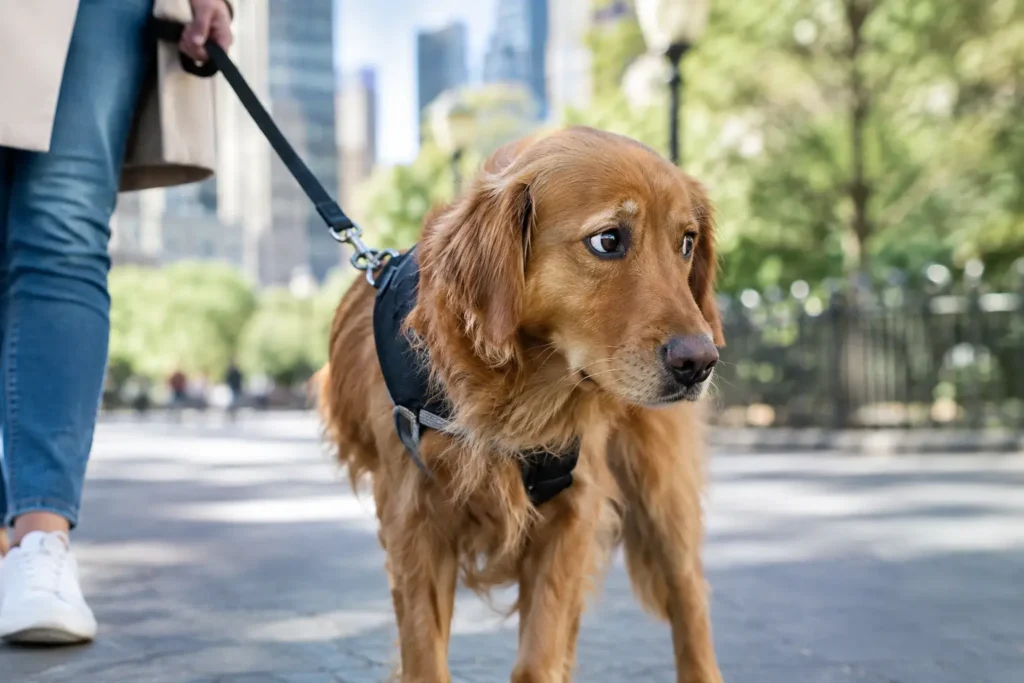
A dog can look perfectly fine at the corner of Broadway and still be telling you, “This is too much.” The best signs of canine stress are often quiet: a sudden lip lick, a head turn away from another dog, a tighter leash, or a refusal to take the usual treat. For Manhattan dogs, busy sidewalks, delivery carts, traffic, elevators, strangers, and close encounters can stack up quickly.
Stress is not a sign that your dog is bad, stubborn, or poorly trained. It is information. When you learn to spot it early, you can give your dog distance, adjust the plan, and help them feel safe before stress turns into pulling, barking, freezing, or fear.
Why stress can be harder to spot in city dogs
New York dogs become skilled at moving through a stimulating environment. They may tolerate subway rumbles, honking, construction, and crowded sidewalks better than visitors expect. But tolerance is not always comfort. A dog who keeps walking may still be overwhelmed, especially if there is no chance to pause, sniff, or create space.
Stress also looks different from dog to dog. A social puppy may become bouncy and mouthy. A sensitive adult dog may slow down, scan every corner, or shut down. A confident dog can still struggle when a normally quiet block is suddenly filled with scaffolding, sirens, or a packed sidewalk. Context matters as much as the behavior itself.
The best signs of canine stress to watch for
A single behavior does not always mean a dog is stressed. Dogs lick their lips after eating, shake off water, and yawn when tired. The clearest clue is a change from your dog’s normal behavior, particularly when several signals appear together or happen around a specific trigger.
Subtle body language signals
Many early stress signals are easy to miss because they happen quickly. Your dog may turn their head away, avoid eye contact, blink repeatedly, lick their lips when no food is present, yawn, or sniff the ground intensely in an unusual moment. These can be polite attempts to calm themselves or communicate that they would rather not engage.
Watch the whole body, not only the face. A relaxed dog usually has soft eyes, an easy mouth, and fluid movement. A stressed dog may have a closed mouth, a furrowed brow, wide eyes that show more white than usual, or a body that looks stiff and held together. Their ears may pin back, swivel constantly, or sit unusually high and forward.
A “shake off” can be another useful clue. If your dog shakes their entire body after passing a noisy truck, greeting an unfamiliar dog, or leaving the elevator, they may be releasing tension. It can be a healthy reset, but repeated shake-offs suggest the environment may be demanding too much of them.
Changes on leash
Leash behavior can reveal stress long before a dog has a major reaction. Some dogs pull hard toward home, rush through an intersection, zigzag, or keep checking behind them. Others plant their feet, move slowly, refuse to leave the building, or suddenly stop taking treats they normally love.
Pulling does not automatically mean excitement or a lack of manners. It may mean your dog is trying to get away from something, reach a familiar place, or regain control in a crowded moment. Likewise, a dog that freezes is not necessarily being defiant. Freezing can be a sign that their nervous system is asking for more time and more distance.
At intersections, pay attention to pace and posture. Heavy traffic, buses, skateboards, and people approaching from several directions can make even a well-trained dog feel trapped. A calm handler can step aside, shorten the route, wait for space, or choose a quieter crossing rather than insisting the dog push through.
Vocalizing and reactive behavior
Barking, growling, lunging, whining, and snapping are more obvious signs that a dog may be over their comfort threshold. They are not behaviors to punish. A growl is valuable communication. If it is ignored or corrected harshly, some dogs stop warning and move more quickly to a bite when they feel cornered.
Instead, focus on safety. Create distance from the trigger, keep the leash steady rather than tight, and avoid forcing a greeting. Once your dog is calm enough to eat and respond, you can redirect to an easier activity or head home. Repeated reactions deserve a thoughtful training plan that builds confidence without flooding your dog with the situations they fear.
Stress at home can look quiet, too
Stress is not limited to walks. A dog who paces, pants in a cool room, follows you from room to room, hides, trembles, or cannot settle may be struggling. Some dogs become unusually clingy when routines change. Others become withdrawn, sleep more, or seem less interested in play.
Destructive behavior can also have several causes. Chewing a shoe, scratching at the door, or raiding the trash may reflect boredom, separation distress, a lack of appropriate outlets, or a medical issue. Look for patterns: Does it happen only after a long day alone? When building noise starts? After a difficult walk? The timing can tell you more than the damaged item.
Common Manhattan stress triggers
Every dog has different sensitivities, but city life creates a few repeat offenders. Keep an eye on how your dog responds to these situations:
- Crowded sidewalks where people pass closely or reach toward your dog
- Construction noise, sirens, delivery carts, buses, and motorcycles
- Tight elevator rides and narrow building entryways
- Surprise dog encounters around corners or outside cafes
- Hot pavement, icy sidewalks, rain, or weather that makes movement uncomfortable
- Long stretches without sniffing, rest, water, or a quieter route
The answer is not to avoid the city altogether. Thoughtful exposure can help many dogs adapt. The trade-off is that exposure needs to stay manageable. A dog who can calmly watch a bus from half a block away may not be ready to stand beside one at a crowded curb.
What to do when you notice stress
Your first job is to lower pressure, not to demand obedience. Increase distance from the trigger if you can. Cross the street, turn down a calmer block, step into a doorway with room, or simply let the other dog pass. Space is one of the most effective tools a dog owner has.
Then make the moment easier. Speak in a calm, normal voice. Keep the leash loose enough for your dog to move naturally while maintaining safety. If your dog will take food, use a few small treats to help them orient back to you or scatter them in a safe spot for a quick sniff break. If they will not take food, do not keep offering it. That may be a sign they need more distance, not more persuasion.
Give your dog permission to opt out of greetings. They do not need to say hello to every person or dog in the neighborhood to be well socialized. A successful walk may mean passing another dog calmly from across the street, choosing a quiet side route, and coming home relaxed.
After a stressful event, build in recovery. A slower sniff walk, a calm chew at home, rest in a quiet room, or a simple food puzzle can help. Avoid adding another high-pressure outing just because the calendar says it is time. Dogs, like people, have limits on what they can process in one day.
When stress may need professional or veterinary support
Call your veterinarian if stress-like behavior appears suddenly, becomes intense, or comes with changes in appetite, sleep, bathroom habits, mobility, or pain. Panting, avoidance, irritability, and restlessness can also be connected to medical discomfort. A behavior plan works best when health concerns have been considered first.
For recurring urban-walk challenges, individualized training can make a meaningful difference. The goal should not be to make a dog endure every distraction. It should be to teach practical skills, build trust with the handler, and create walks that feel safe and predictable. One-on-one support is especially helpful for dogs who pull, freeze, react at intersections, or struggle with close dog encounters.
At Pet Love NYC, we see the value of consistent handling, clear communication, and walks shaped around the individual dog. A thoughtful walker notices when a dog needs a little more space, a quieter block, or a slower pace – and shares those observations with the family.
Your dog does not need to be cheerful through every siren, sidewalk crowd, or surprise encounter. When you notice their small signals and respond with patience, you teach them something far more useful than “push through”: you teach them that you are listening.