


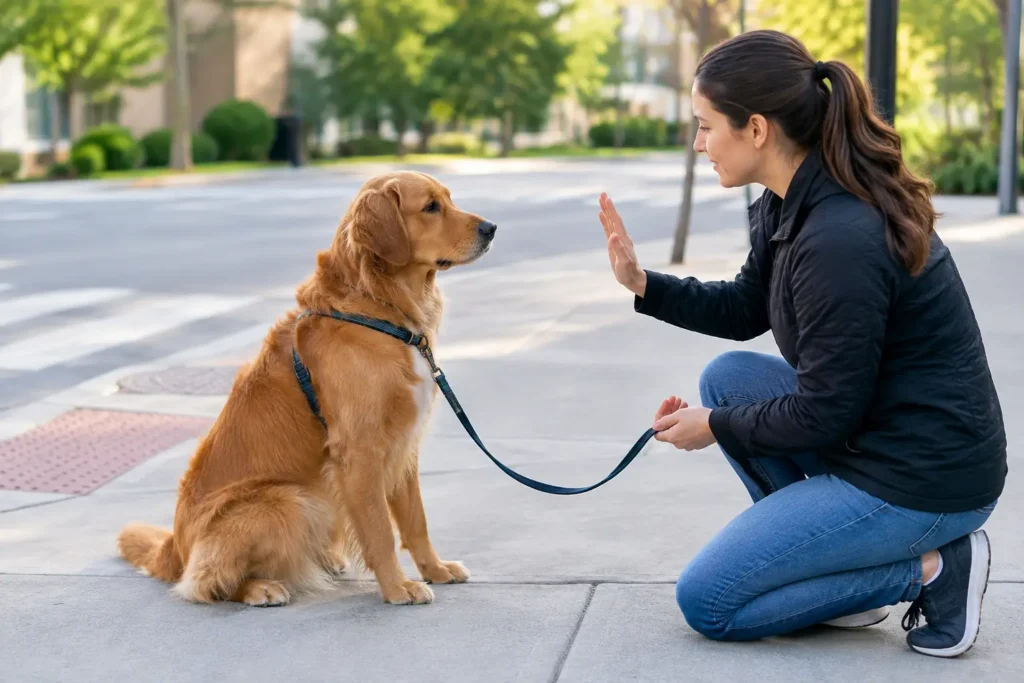
A Manhattan intersection can change in one second. A delivery cart rattles by, a bus exhales at the curb, another dog appears across the street, and the light changes before your dog has finished sniffing. When you teach dog intersection pauses, you give them a simple, repeatable job in the busiest part of the walk: stop, reconnect with you, and wait for the next cue.
This is not about making your dog sit perfectly at every corner or turning a walk into a drill. It is about building a safety habit that works when real city life gets loud, crowded, and unpredictable. A clear pause helps prevent leash pulling into traffic, reduces rushed crossings, and gives your dog a moment to settle before moving forward.
Why intersection pauses matter on city walks
Dogs do not automatically understand that a curb is a boundary. To many dogs, it is simply the place where an exciting smell, a pigeon, or a person with a sandwich happens to be waiting. Add the momentum of a brisk walk, and it is easy for a dog to pull ahead without checking where you are going.
A pause creates a predictable pattern: curb means slow down, stand with your person, and wait. Over time, that pattern can lower arousal because your dog no longer has to guess what happens at each corner. They have a familiar routine, and familiar routines are reassuring.
The benefit is especially meaningful for puppies, energetic dogs, newly adopted dogs, and dogs who become overstimulated outside. It also helps handlers make better decisions. Instead of being pulled into a crosswalk while watching traffic, bikes, and turning cars, you have a beat to gather the leash, observe the intersection, and cross with intention.
Start with the right goal
For most dogs, the best intersection pause is a calm stop beside or slightly behind your leg, with enough slack in the leash for comfort. Your dog may stand, sit, or look around quietly. The goal is not a formal obedience pose. The goal is that they do not step off the curb until you give a release cue.
That distinction matters. Asking every dog to sit at every corner can be uncomfortable for older dogs, dogs with joint pain, or dogs walking on wet, hot, or gritty pavement. Some dogs also find a standing pause easier when the sidewalk is crowded. Choose the position that keeps your dog comfortable and makes the behavior reliable.
Pick one release word, such as “let’s go,” “cross,” or “okay.” Use it only when you are ready to move. If “okay” already means many things at home, choose a new word for street crossings so it remains clear and meaningful.
How to teach dog intersection pauses step by step
Practice the pattern before the busy corner
Begin in a quiet hallway, building lobby, calm block, or low-traffic side street. Walk a few steps with your dog on a regular leash. Stop gently, say your pause cue – “wait” is a good option – and reward your dog for stopping with you.
At first, reward the moment your dog pauses, even if it lasts only one second. Then say your release word and walk forward together. Repeat several short rounds. Your dog is learning that stopping does not end the fun. It simply earns a treat and leads to the next part of the walk.
Keep your body language simple. Avoid pulling your dog backward or repeating the cue several times. If they continue forward, calmly prevent access with the leash, take a step back if needed, and try again from an easier distance. A cue works best when it is information, not a warning.
Add the curb as the signal
Once your dog understands the stop-and-release pattern, bring it to an easy intersection. Approach the curb at a pace that gives both of you room to slow down. About a step or two before the curb, say your cue, stop, and reward when your dog stops with you.
For the first few sessions, reward generously. Give a small treat at the curb, praise in a warm voice, and release only when it is safe to cross. The crossing itself is also a reward, especially for dogs who are eager to explore the next block.
If your dog reaches the end of the leash and plants their feet at the curb, do not drag them back into position. Move away from the intersection by a few steps, regain their attention, and approach again at a calmer pace. This may feel slower in the moment, but it prevents your dog from rehearsing the habit of charging toward the street.
Build duration slowly
A one-second pause is a win at the beginning. After your dog is consistently stopping, wait two seconds before rewarding. Then three. Gradually work toward the amount of time you realistically need for a signal change or for traffic to clear.
During the pause, let your dog look around. They do not need to maintain eye contact with you while a bus, jogger, and other dog pass by. What matters is that they stay with you and do not move into the street. If they choose to look back at you, reward that check-in warmly.
Use higher-value treats around major distractions. Soft, easy-to-eat rewards are helpful because you can deliver them quickly without fumbling at the curb. Save a favorite treat for intersections near dog parks, food carts, construction sites, or other places where your dog usually loses focus.
Make the release cue count
Many dogs break a pause because the handler begins walking without saying anything. From the dog’s perspective, forward motion becomes the release. Be consistent: say your release word first, then start moving.
If your dog steps forward before the cue, simply stop. Wait for even a brief reset, then release and proceed. There is no need for a correction or frustration. The lesson is straightforward: waiting makes the walk continue; pulling ahead makes the walk pause.
Handle real Manhattan distractions with care
Training at intersections is not the time to prove how much your dog can handle. If a siren is approaching, a crowded group is spilling onto the sidewalk, or a dog is lunging across the street, create distance when you can. Turn down a quieter block, step into a doorway only if it is safe and allowed, or cross at the next light.
A dog who is over threshold cannot learn well. Signs include hard staring, frantic pulling, barking, spinning, refusing food, or appearing unable to hear familiar cues. In that moment, prioritize safety and space over a perfect pause. You can practice the skill again when your dog is calm enough to succeed.
Equipment matters, too. A well-fitted harness and a standard fixed-length leash generally give you better communication than a retractable leash near traffic. Avoid attaching your dog to an object while you manage a busy intersection, and keep the leash short enough for safety without holding it tight all the time. Constant tension can make dogs pull harder and can make them feel trapped.
Common mistakes that slow progress
The most common mistake is asking for too much too quickly. A dog who can pause in a quiet lobby may not be ready to pause beside a jackhammer on Eighth Avenue. Build difficulty in small steps: quiet corner first, then a moderately busy block, then a more distracting route.
Another is using the pause cue after your dog has already surged ahead. Try to give the cue before the leash tightens. This teaches your dog to respond to your words and the approach to the curb, rather than waiting until physical pressure stops them.
Finally, do not reserve rewards only for flawless performances. Reward the small choices that lead to safety: slowing down near the curb, turning back toward you, keeping a loose leash, or waiting one extra second. Those choices become dependable habits through repetition.
When personalized leash training helps
Some dogs need more than a few practice walks. If your dog pulls hard enough to make crossings feel unsafe, freezes at corners, reacts strongly to traffic or other dogs, or cannot take food outside, individualized support can make a real difference. The plan should fit your dog’s temperament, history, physical comfort, and neighborhood routine.
At Pet Love NYC, our leash training workshops focus on the urban moments that matter most, including distraction management, pulling, and intersection behavior. One-on-one guidance can help you read your dog’s signals, use timing more clearly, and practice on the streets you walk every day.
Start small, keep the cue consistent, and celebrate calm choices. With patient repetition, the curb can become a quiet moment of connection – a place where your dog learns that staying close to you is safe, rewarding, and always worth it.