


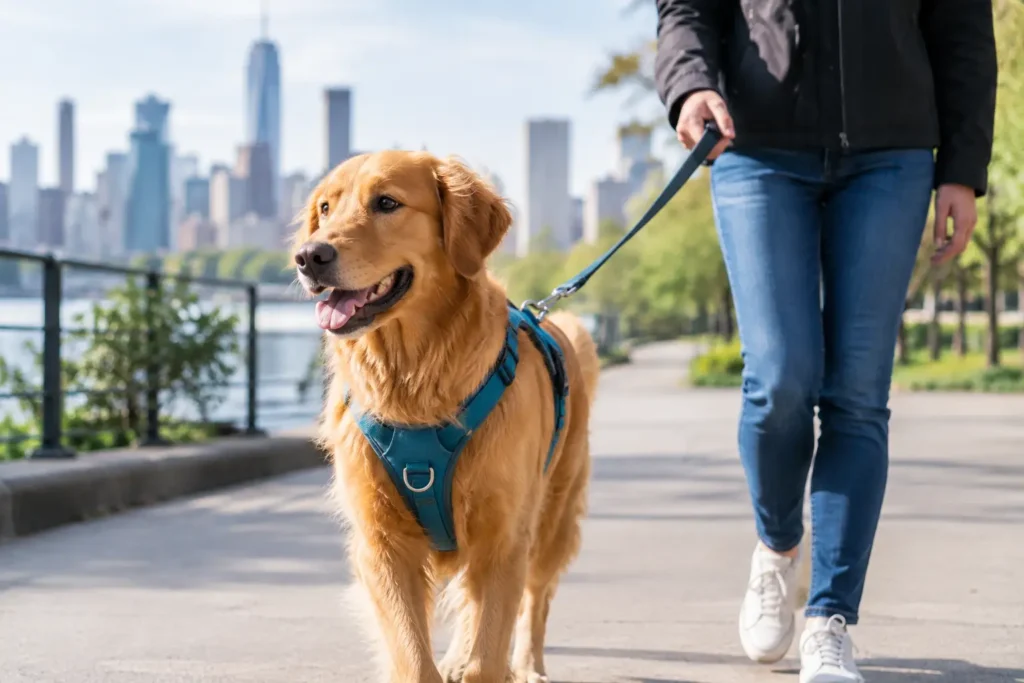
Should dogs wear harnesses? For many Manhattan dogs, the answer is yes – but the right harness, proper fit, and calm leash handling matter far more than the label on the package. On a crowded sidewalk, a dog may stop suddenly for a pigeon, surge toward a familiar neighbor, or feel overwhelmed by a bus passing inches away. The equipment you choose should help keep your dog comfortable and connected to you through all of it.
A harness is not automatically safer for every dog or every situation. Some designs restrict natural shoulder movement. Others are too loose, too tight, or simply give a powerful puller more leverage. The best choice comes down to your dog’s body, behavior, health needs, and the kind of walks you take together.
Should dogs wear harnesses for city walks?
A well-fitted harness is often an excellent choice for urban walks because it spreads leash pressure across the chest and torso rather than concentrating it at the neck. That can be especially helpful for puppies, small breeds, flat-faced dogs, dogs with delicate tracheas, and dogs who are still learning not to pull.
In New York City, walkers need to make quick, gentle adjustments all the time: stopping before a curb, creating space from another dog, moving around construction, or redirecting attention away from dropped food. A harness gives you a more secure point of contact without needing to put pressure on your dog’s throat.
It also helps with safety when fitted correctly. Dogs can slip out of a collar when startled, particularly if they back up or twist away from a sound or unfamiliar person. Some harnesses are designed with an extra belly strap for escape-prone dogs. That added security can bring peace of mind, but it still needs to be paired with close supervision and a properly attached leash.
The key word is well-fitted. A harness that rubs behind the front legs, sits across the shoulders, or hangs loose around the chest can turn a helpful tool into an uncomfortable one.
What a good harness should allow your dog to do
Your dog should be able to walk, sniff, stretch, and turn comfortably. Look for a harness with a Y-shaped front that rests along the chest instead of a horizontal strap that crosses tightly over the shoulders. The chest piece should sit on the breastbone, not high on the throat, and the straps should stay clear of the armpits.
You should generally be able to slide two fingers under the straps. If you can fit a whole hand under them, the harness may be loose enough for your dog to back out. If your fingers cannot fit, it may be too tight and can cause rubbing, pinching, or restricted movement.
Check the fit more than once. Puppies grow quickly, coats change with the seasons, and even a small weight change can affect how a harness sits. Watch your dog after a walk, too. Red marks, missing fur, repeated scratching at the harness, or reluctance to move are signs that something needs adjusting.
The attachment point matters
Back-clip harnesses are comfortable and simple for many dogs, especially relaxed walkers. However, if a dog pulls hard, a leash attached at the back can encourage forward momentum – much like a sled dog pulling from behind the shoulders.
Front-clip harnesses can be useful for dogs learning polite leash manners. When a dog pulls, the front attachment gently turns the body back toward the handler rather than allowing the dog to drive straight ahead. They are a management tool, not a cure for pulling, and they need careful adjustment so the leash does not twist the harness or interfere with the front legs.
For some dogs, a dual-clip harness with both front and back attachment points gives the handler more control in distracting areas. The right setup should feel steady and humane, never like a constant correction.
When a collar may be the better choice
A flat collar still has an important role. It is a convenient place for your dog’s ID tags and can work well for dogs who already walk on a loose leash without lunging or pulling. Many owners use a collar for identification and a harness for walks, which is often a practical combination.
For a dog who is sensitive to wearing gear, a collar may also be less stressful at first. Build positive associations before insisting on either option. Let your dog sniff the harness, offer treats as it goes over the head or around the body, and keep early wearing sessions brief and pleasant.
There are medical exceptions, too. Dogs with shoulder injuries, skin conditions, breathing concerns, or unusual body shapes may need specific equipment recommendations from a veterinarian. If your dog seems painful, changes their gait, or suddenly resists the harness, pause and get professional guidance rather than trying to walk through the problem.
A harness will not teach loose-leash walking by itself
This is the part many busy dog owners understandably hope to skip: equipment supports training, but it cannot replace it. A front-clip harness may reduce the force of pulling, yet your dog still needs to learn what you would like them to do instead.
Start by rewarding the behavior you want. When the leash is loose, your dog is near your side, or they look back at you after noticing a distraction, offer warm praise and a small treat. On city walks, those moments may last only a second at first. They still count.
When the leash tightens, avoid turning the walk into a tug-of-war. Stop, create a little space, or calmly change direction when it is safe to do so. Then reward your dog when they return to a loose leash. Consistency matters more than a perfect walk. A dog who pulls toward every greeting or squirrel is not being difficult on purpose – they are practicing a behavior that has worked for them before.
Intersection behavior deserves special attention in Manhattan. Before stepping off the curb, ask for a brief pause and make sure the leash is organized in your hand. Keep your dog close enough to prevent darting into foot traffic, but do not hold them so tightly that they cannot move naturally. With repetition, that small routine becomes a reliable safety habit.
At Pet Love NYC, individualized walks and leash training focus on the dog in front of us, not a one-size-fits-all rule. A high-energy young dog may need help channeling excitement around other dogs, while a shy rescue may benefit from more distance, slower pacing, and plenty of reassurance.
Choosing a harness for your dog’s real life
The best harness is one your dog can wear comfortably and you can use confidently. Before committing to a model, consider how your dog walks, what tends to distract them, and whether they have ever slipped out of their equipment. A sturdy harness with clear adjustment points may be worth more than a fashionable one that shifts around after five blocks.
Avoid relying on retractable leashes in busy areas, even with a harness. They make it harder to control distance near traffic, cyclists, food carts, and other dogs. A standard fixed-length leash offers clearer communication and gives you more time to respond to the unexpected.
Also inspect the harness regularly. Look for frayed webbing, damaged buckles, loose stitching, and worn attachment rings. City walks put equipment through plenty of use, especially in rain, snow, and summer heat. Clean it when needed and replace it before a small issue becomes a safety concern.
Give your dog time to adjust
Some dogs accept a harness immediately. Others freeze, roll, scratch, or act as if the new strap has changed their whole day. Go slowly. Pair the harness with treats, meals, or a favorite sniff walk, and keep your voice calm. For a nervous dog, forcing the process can make future walks harder.
The goal is not simply to get a harness on your dog. It is to help them feel safe, move comfortably, and enjoy the attention, exercise, and little neighborhood adventures that make a good walk feel like more than a bathroom break. If your dog is comfortable and you are prepared, the city becomes a much easier place to explore together.