


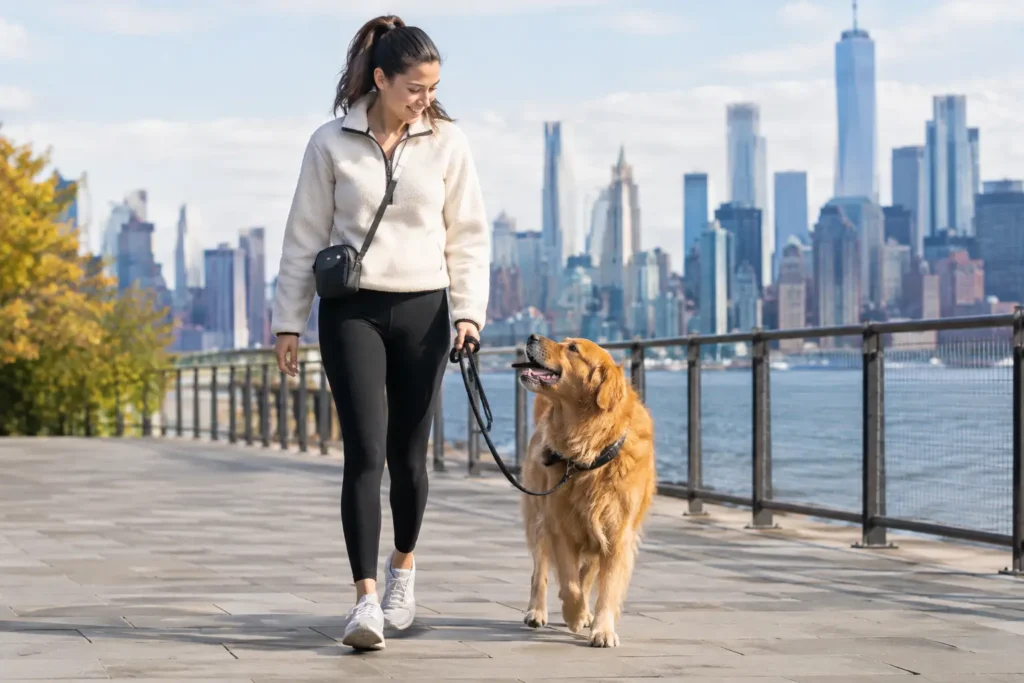
A Manhattan walk can ask a lot of a dog before they have even reached the corner: a delivery cart rattles past, another dog appears across the street, a taxi horn sounds, and the scent of last night’s pizza is suddenly fascinating. The most useful leash training trends are not about making every dog walk in a rigid heel. They are about helping dogs feel safe, understood, and responsive in the real environments where they live.
For busy New York City dog owners, that shift matters. A walk should provide exercise, bathroom time, enrichment, and a chance to decompress – not a daily struggle with pulling, lunging, or rushed corrections. The best modern approach combines clear communication, consistent handling, and training plans that respect the individual dog in front of you.
Leash Training Trends Favor Individual Dogs
For years, leash manners were often reduced to one goal: teach a dog not to pull. Pulling still needs attention, especially near traffic or crowded intersections, but it is rarely the whole story. A puppy may pull because everything is new. A high-energy adolescent may pull because they need more appropriate exercise and practice. A nervous rescue dog may pull to create distance from a person, bike, or barking dog.
That is why individualized training has become so valuable. Instead of applying the same correction or equipment to every dog, skilled handlers look for patterns. What happens before the leash goes tight? Is the dog overstimulated at the start of the walk, uncomfortable around other dogs, or simply unclear about what earns forward movement?
A plan can then fit the dog’s needs. Some dogs benefit from short, focused practice near home before taking a longer route. Others need a quieter walking time, more distance from triggers, or a few minutes to sniff and settle before they can concentrate. Progress is not always a perfectly straight line, particularly in a city full of surprises.
Calm Walking Is Replacing Constant Corrections
One of the strongest leash training trends is the move away from correcting every mistake and toward rewarding the behavior owners actually want to see. When a dog checks in, slows down, turns away from a distraction, or keeps a loose leash for several steps, that is useful information worth reinforcing.
Rewards do not always have to mean treats, though food can be very effective. In many cases, the reward is getting to move forward, sniff a tree, greet a familiar neighbor, or continue toward the park. The key is timing. If a dog learns that a loose leash makes good things happen, they begin to see walking with their person as a clear, cooperative conversation.
This does not mean boundaries disappear. Dogs need limits around traffic, crosswalks, doorways, and other people’s personal space. Calm training simply makes those limits easier to understand. A steady pause at the curb, a consistent cue before crossing, and a handler who does not add tension to an already exciting moment can make a major difference.
Why city dogs need practical cues
Dogs do not need a long vocabulary to walk well in Manhattan. They do need cues that work when the sidewalk is crowded and their handler needs an immediate response. A reliable name response, a cue to turn with the handler, a brief pause at a curb, and a way to move away from distractions can be more valuable than an elaborate set of tricks.
The goal is not military precision. It is safety and confidence. A dog who can notice a skateboard, look back to their handler, and continue walking calmly has learned a skill that supports a better life in the city.
Equipment Choices Are Becoming More Thoughtful
Another important trend is a more careful conversation about walking equipment. There is no single collar, harness, or leash that is right for every dog. Size, body shape, medical needs, pulling intensity, and behavior around triggers all affect the decision.
A well-fitted harness may provide better control and reduce pressure on a dog’s neck, especially for a small dog or a dog that tends to lunge. For some dogs, a standard flat collar is perfectly appropriate for identification while a harness handles the walking work. A fixed-length leash often gives clearer communication than a retractable leash on congested sidewalks, where extra distance can quickly become unsafe.
Equipment should support training, not replace it. A new harness may improve management right away, but it will not teach a dog how to handle a close pass by another dog or stop at an intersection. Conversely, even excellent training can be undermined by gear that pinches, slips, or causes discomfort. Fit and comfort are part of responsible leash training.
Sniffing Has Earned Its Place on the Walk
Many owners were taught that allowing a dog to sniff is a distraction from the “real” walk. Current training approaches recognize that sniffing is often valuable enrichment. Dogs gather an enormous amount of information through scent, and a few unhurried sniff breaks can help make a walk mentally satisfying.
The trade-off is that New York sidewalks require structure. A dog cannot be allowed to wander into a bike lane, pull toward food scraps, or block a building entrance. The practical middle ground is a walk with different modes: a closer, more focused leash near intersections and crowds, followed by safe opportunities to sniff along a quieter block, in a designated green space, or beside a tree.
This balance can reduce frustration for dogs who pull because they are desperate to investigate their environment. It also helps owners remember that a successful walk is not measured only by distance covered. A dog who returns home physically exercised and mentally settled has had a more complete outing.
Trigger Management Is More Realistic Than Forced Greetings
Socialization does not require every dog to meet every dog. This is especially true in a dense neighborhood, where a friendly greeting can become chaotic in seconds if one dog is fearful, overexcited, on a tight leash, or guarding their space.
Modern leash training puts more emphasis on neutral passing. That means teaching dogs that they can notice another dog, person, stroller, or scooter without needing to rush toward it or react to it. Distance is a training tool, not a failure. Crossing the street, stepping into a doorway, or choosing a wider route can give a dog the space needed to stay under threshold and learn.
Owners sometimes worry that avoiding a trigger means they are giving in. In reality, repeated stressful encounters can make behavior worse. Creating a manageable situation gives the dog a chance to practice a better response. As confidence grows, the distance can be adjusted thoughtfully.
Consistency matters more than intensity
A dog does not need one exhausting training session followed by a week of mixed messages. They benefit from calm, repeatable routines. If one person lets the dog pull to every tree while another expects a loose leash at all times, the dog receives conflicting information.
This is one reason a consistent professional walker can be so helpful for working households. The walker can use the same cues, safety practices, routes, and reward timing during daytime walks, then share what they are seeing. Check-in alerts, walk summaries, photos, videos, and honest behavior updates help owners continue that progress at home rather than wondering how the walk went.
Training Is Becoming Part of Everyday Care
The most encouraging trend is that leash work is no longer treated as something reserved for puppies or dogs with a serious behavior issue. Every walk offers small teaching moments. Waiting politely while a leash is clipped on, choosing to look at a handler after hearing a truck, or walking past a dropped bagel without lunging are meaningful wins.
For a puppy, those wins build a foundation before city distractions become overwhelming. For an adult dog, they can replace habits that have become automatic. For a senior dog, a gentler pace and predictable routine can make outings more comfortable. The methods may differ, but the principle remains the same: a dog deserves handling that considers both behavior and emotional well-being.
At Pet Love NYC, we believe dependable walks and leash training should feel personal, not like a crowded pack routine. One-on-one attention gives a handler room to notice the small details: the block where a dog gets tense, the cue that helps them reset, and the kind of praise that brings out their confidence.
If walks have become stressful, start small. Choose one calm route, practice one useful cue, and celebrate the moments when your dog chooses connection over chaos. With patient repetition and a handler your dog trusts, even a busy Manhattan sidewalk can become a place where they feel safe, capable, and happy to walk beside you.