


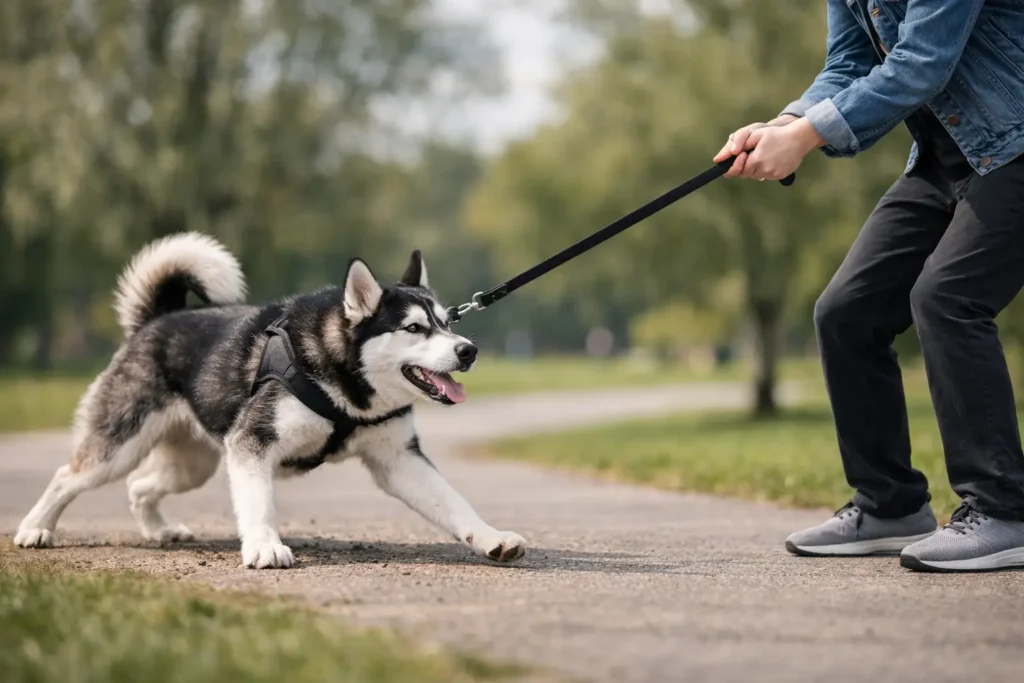
The hardest part of leash training usually is not your living room. It is the moment your dog hits the sidewalk, catches a smell, spots another dog, or surges toward the corner like they have somewhere urgent to be. If you are wondering how to stop leash pulling outside, the answer is rarely more force. It is better timing, clearer communication, and practice in the places that actually challenge your dog.
In Manhattan, leash pulling is not just frustrating. It can become a safety issue fast. A dog that lunges at a crosswalk, drags toward food on the ground, or hits the end of the leash near traffic can turn a simple walk into a stressful one. The good news is that pulling is a trainable behavior, and most dogs improve when their handler stops reacting randomly and starts building a consistent pattern.
Why dogs pull more outside
Outside is a completely different environment from indoors. Your dog is processing movement, sounds, scents, other dogs, delivery carts, people stepping around them, and the general pace of city life. Pulling often happens because dogs move toward what they want, and the leash has accidentally taught them that tension works. If they pull and eventually reach the tree, the fire hydrant, or the pigeon, the pulling got rewarded.
That does not mean your dog is stubborn or trying to dominate the walk. In most cases, they are excited, overstimulated, under-practiced, or simply unclear on what is expected. Puppies pull because the world is brand new. High-energy adult dogs pull because they are eager and fast. Nervous dogs may also pull because they want distance from something that worries them. The reason matters, because the right solution depends on what is driving the behavior.
How to stop leash pulling outside without a fight
The first shift is mental. Your goal is not to win a tug-of-war. Your goal is to teach your dog that staying with you is what makes the walk continue.
Start with equipment that supports training, not equipment that masks the problem. A well-fitted front-clip harness can help reduce the dog’s ability to power forward, especially for strong pullers. A standard leash gives you better communication than a retractable leash, which tends to keep constant tension in the system. Whatever you use, fit matters. If the harness rubs, twists, or allows escape, training gets harder and safety drops.
Once your gear is sorted, work on one simple rule: slack leash moves forward, tight leash pauses the walk. That sounds basic, but consistency is everything. The second your dog forges ahead and the leash tightens, stop. Do not yank back, do not keep marching, and do not let the pulling carry them closer to what they want. Wait for even a small check-in, a step back, or a moment of slack, then continue.
At first, this can feel painfully slow. That is normal. If your dog has spent months practicing pulling, they will not change in one block. But when the rule stays the same every time, dogs start to understand that pulling stalls progress and staying connected keeps the walk moving.
Teach attention before you need it
One reason outdoor walks unravel is that many dogs have never learned how to reconnect with their person in a distracting environment. Before you ask for a perfect heel on a busy avenue, teach a simple check-in.
Say your dog’s name in a calm, upbeat voice. The moment they look at you, mark it with praise and reward. Then keep walking. You are not trying to stop the walk every ten seconds for a formal training session. You are showing your dog that noticing you is always worth it.
This matters most before distractions fully take over. If your dog is already locked onto a squirrel or another dog, you are late. Try to catch attention early, when you see the distraction coming but your dog is still able to think. In city walking, prevention is often more effective than correction.
Use short practice zones
Do not expect your dog to learn leash manners during a full, chaotic route right away. Pick a short stretch of sidewalk, a quieter side street, or the calmer part of a block and treat it as your training zone. Walk ten to twenty steps with focus, then give your dog a release to sniff.
That balance helps a lot. Dogs need structure, but they also need decompression. If every walk becomes rigid and overmanaged, some dogs get more frustrated and pull harder. Letting them earn access to sniffing and exploring teaches that calm walking does not remove freedom. It creates it.
Reward the behavior you actually want
Many owners talk to dogs most when the dog is doing something wrong. Outside, that often sounds like repeated no, stop, wait, easy, or heel without much follow-through. Dogs learn faster when we are just as clear about the right choice.
Reward your dog when they are beside you, when they glance up at you, when they slow down on their own, and when they match your pace. Rewards can be treats, praise, permission to move forward, or a quick sniff break. Food is especially helpful in the learning phase because outdoor distractions compete hard for your dog’s attention.
If treats seem to stop working outside, it usually means one of two things. Either the environment is too difficult for your dog’s current skill level, or the reward is not valuable enough. In a high-distraction area, dry kibble may not stand a chance against street smells and passing dogs. Better rewards and easier setups often solve what looks like stubbornness.
How to stop leash pulling outside in busy areas
Busy areas require management as much as training. There is no prize for forcing your dog through the hardest possible route while they are still learning. If one intersection always causes lunging, change your approach. Cross earlier, create more distance, or pause in a quieter spot until the trigger passes.
Distance gives dogs room to stay under threshold, which means under the level of excitement or stress where listening falls apart. A dog who can respond at twenty feet may not be able to respond at five. That is not failure. It is information.
This is especially true for dogs who pull toward other dogs, food, scooters, or crowds. In those moments, your job is not to prove your dog can handle everything. Your job is to set up repetitions they can succeed in. Safer, calmer practice leads to faster progress than overwhelming your dog day after day.
When pulling is really about emotion
Not every pulling problem is about excess energy. Some dogs rush because they are anxious. Some lag and then surge because they are unsure. Some scan every corner and tighten the leash because city movement feels unpredictable.
If that sounds like your dog, focus less on precision and more on confidence. Keep your route predictable. Give your dog extra space from triggers. Use a calm pace and simple patterns. A dog who feels safer will often pull less because they are no longer trying to control the environment themselves.
Common mistakes that slow progress
The biggest mistake is inconsistency. If your dog pulls for three blocks and still gets to the park, the pulling is being practiced and rewarded. Everyone who walks your dog needs to use the same rules, or your dog will get mixed messages.
Another common issue is asking for too much too soon. A loose leash for half a block is a great start. Expecting a perfect walk through midday Manhattan on day three is not realistic for most dogs. Progress usually comes in layers: less tension, faster recovery, more check-ins, better corners, calmer passes by distractions.
Physical exercise matters too, but it is not the whole answer. A tired dog is not always a trained dog. Some dogs get physically fitter and simply become stronger pullers. Pair exercise with skill-building so your dog learns how to walk, not just how to burn energy.
When extra help makes sense
If your dog is strong, reactive, highly distracted, or has been pulling for a long time, outside coaching can make a real difference. Timing is hard to learn on your own, especially on crowded sidewalks where things change by the second. One-on-one leash training can identify whether your dog needs better fundamentals, more impulse control, a calmer route, or a different handling approach.
That is why individualized support tends to work better than generic pack-walk routines for dogs with leash issues. Pulling is personal. The triggers, pace, stress level, and motivation behind it vary from dog to dog. At Pet Love NYC, we see the best progress when training matches the actual dog in front of us, not a one-size-fits-all formula.
Leash pulling outside gets better when your dog learns that walks are a conversation, not a race. Stay clear, stay patient, and let small wins count. A calmer walk usually starts with a calmer plan.