


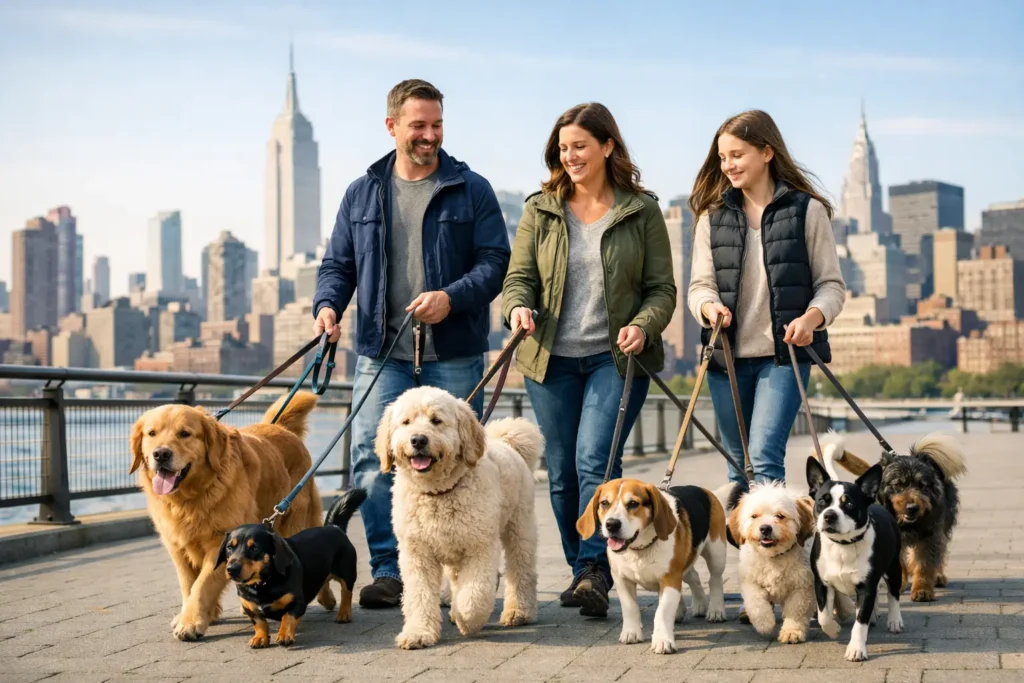
If you share your home with two or more dogs, you already know that walking them is rarely as simple as clipping on a couple of leashes and heading outside. One dog wants to sprint to the corner. Another freezes at the elevator. A third gets overstimulated the second a delivery bike flies by. That is exactly why same household group dog walks can be such a smart fit for busy Manhattan homes – they let dogs who already live together walk together, while still getting handling that is thoughtful, structured, and safe.
For city owners, that distinction matters. A same-household walk is very different from a large pack walk made up of unrelated dogs with different temperaments, training levels, and comfort zones. When dogs know each other, share a routine, and return to the same home, the walk can feel more predictable for them and more practical for you. But it only works well when the dogs are matched carefully, handled with skill, and given the kind of attention that keeps the outing calm instead of chaotic.
What same household group dog walks really mean
Same household group dog walks are designed for dogs from the same family. That might mean two siblings, an older dog and a puppy, or a bonded pair who are used to moving through the world together. The key point is that the dogs already share a home, a relationship, and a daily routine.
That matters because familiarity changes behavior. Dogs living in the same household often understand each other’s signals better than unrelated dogs do. They know who walks fast, who needs space, who startles easily, and who likes to take the lead. A skilled walker can use that familiarity to create a more coordinated, less stressful outing.
In a city like New York, that structure is essential. Sidewalk traffic, noise, intersections, scooters, food scraps, and other dogs create constant distractions. Walking multiple dogs together only works when the handler is paying attention to pacing, leash position, body language, and the environment at the same time.
Why multi-dog homes often benefit from walking together
For many households, the biggest benefit is convenience, but convenience is only part of the story. Dogs who live together often enjoy shared activity. Walking at the same time can support routine, reduce midday boredom, and help dogs settle more easily once they are back home.
It can also be emotionally reassuring. Some dogs are more confident when their housemate is nearby. A younger or more nervous dog may move through the block more comfortably with a familiar companion. On the other hand, a confident older dog can help set a steadier pace for the group.
There is also a practical rhythm to it. Instead of having one dog walked at noon and another later in the afternoon, same-household group walks give the home a more unified schedule. For working professionals, that often means less disruption and clearer expectations during the day.
Still, together is not always automatically better. If one dog is highly reactive and the other is easily influenced, they may feed off each other’s tension. If one dog needs a true training-focused walk and the other just needs exercise, separate walks may sometimes be the better option. Good care is never one-size-fits-all.
Same household group dog walks vs. pack walks
This is where many owners get understandably cautious. They hear “group walk” and picture a single walker being dragged down the block by a crowd of unrelated dogs. That is not the same service.
Same household group dog walks are smaller, more controlled, and more personal by design. The dogs already know each other. Their health history, walking style, and home routine are easier to understand. There is no added uncertainty from introducing outside dogs with unknown habits or conflicting energy.
That difference affects safety in a major way. When a walker is not juggling a large pack, there is more room to notice subtle signs of stress, adjust speed, reinforce good leash behavior, and respond quickly at curbs and intersections. For Manhattan dog owners, that level of attention is not a luxury. It is part of responsible urban care.
When walking dogs together makes the most sense
The best candidates are dogs who already move well together at home and show reasonably compatible walking styles. That does not mean they need identical personalities. In fact, many successful pairs are different in ways that balance each other out. A playful dog and a calmer dog can do beautifully together if the handling is structured.
Same-household walks often work especially well for bonded pairs, siblings, adult dogs with an established routine, and homes where both dogs need midday exercise but not separate, behavior-intensive sessions every day. It can also be a strong option for owners who want consistency and communication without sacrificing individualized awareness.
Puppies can sometimes join same-household group walks too, but only when their developmental stage, stamina, and training needs are considered honestly. A puppy may benefit from walking with an older household dog, yet still need shorter sessions, slower pacing, or more frequent stops. That is why thoughtful service starts with assessment, not assumptions.
What a good walker is watching during the walk
A strong same-household walk is never just about covering distance. The real work is in how the dogs are managed from the moment the leash goes on.
An experienced walker is paying attention to arousal level before the door even opens. If one dog is already spinning with excitement while the other hangs back nervously, that affects the first few minutes of the outing. The same goes for elevator exits, lobby traffic, and the first busy corner. These transition points often tell you whether the walk will be smooth or need a slower reset.
Leash handling matters just as much. Dogs from the same home may still need different amounts of space, different walking sides, or occasional repositioning depending on triggers around them. A walker should be adjusting in real time, not simply letting the group pull itself forward.
City walks also demand strong judgment. If the block is unusually crowded, if construction noise spikes, or if another dog is approaching in a way that could create tension, the route may need to change. Good walkers do not force a plan when the environment is clearly asking for a different one.
Why individualized attention still matters in a group setting
This is the part many owners care about most, and rightly so. Just because dogs walk together does not mean their individual needs disappear.
One dog may need more encouragement leaving the building. Another may need consistent reinforcement for leash manners. A third may need a slower pace due to age or recovery. In the best same-household group dog walks, the dogs benefit from being together without becoming interchangeable.
That is the standard we believe in at Pet Love NYC. Even when dogs share a walk, they still deserve to be seen as individuals. Their comfort, pace, and behavior cues matter separately. That is what keeps a shared walk from becoming generic.
Communication with owners matters here too. A useful update does more than say the dogs “did great.” It should tell you if one dog was hesitant at the start, if another had more energy than usual, or if leash manners improved on a difficult block. Those details build trust because they show that someone is truly paying attention.
How to decide if your dogs should walk together
The best question is not, “Can both my dogs physically be walked at once?” It is, “Will both my dogs benefit from walking together?” Those are not always the same thing.
Think about energy level, age, confidence, leash skills, and how your dogs influence each other. If they settle one another, move at a compatible pace, and generally navigate stimulation well as a pair, a shared walk may be ideal. If they compete, escalate, or have very different needs, a mix of group walks and solo walks may be smarter.
A consultation helps sort that out. It gives the walker a chance to observe door manners, leash reactions, household dynamics, and any urban challenges that show up quickly once the dogs step outside. That early assessment can prevent a lot of stress later.
For Manhattan households, the right walking plan is usually the one that combines efficiency with genuine care. Same-household group walks can absolutely do that, as long as safety, communication, and individualized handling remain at the center of the service.
When your dogs come back home exercised, calm, and cared for, you feel the difference right away. The apartment is quieter. The afternoon is smoother. And you know your dogs were not just walked – they were understood.