


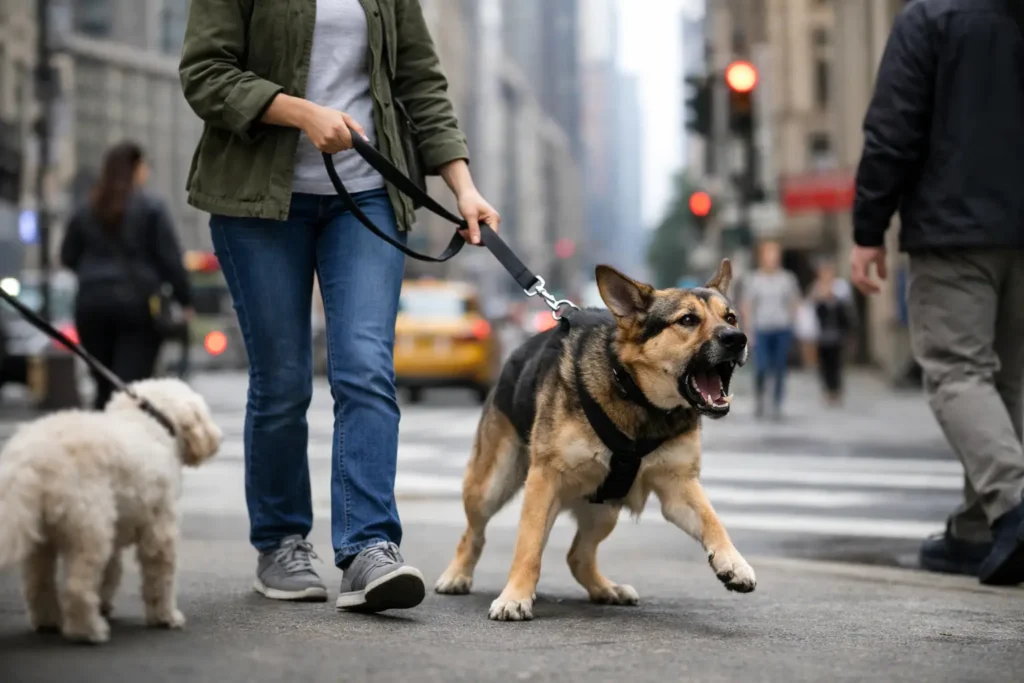
The hardest part of learning how to walk reactive dog in city life is that the city rarely gives you a quiet moment to practice. A delivery bike appears out of nowhere. An elevator opens and another dog steps out. A crowded sidewalk narrows fast, and now your dog is over threshold before you can even think. If that sounds familiar, you are not failing your dog. You are dealing with a real behavior challenge in one of the most distracting environments possible.
Reactive dogs are not giving you a hard time. They are having a hard time. In Manhattan and other dense neighborhoods, that distinction matters because the goal is not to force perfect behavior through pressure. The goal is to help your dog feel safer, more predictable, and more able to move through the world without panic, lunging, barking, or frantic pulling.
How to walk reactive dog in city settings starts before the door
Most difficult walks begin before the leash is even clipped on. If your dog is already pacing, whining, spinning, or launching toward the hallway, the walk starts with too much arousal. That does not mean your dog should not go out. It means the transition needs more structure.
Give yourself an extra few minutes. Wait for a small moment of calm before opening the door. Keep your own movements steady and quiet. Many dogs read our tension immediately, especially when we are bracing for a bad encounter in the lobby or on the block.
Equipment matters too, but it is not magic. A well-fitted harness can give you better control without putting pressure on the neck. A standard leash usually gives you better communication than a retractable leash in tight city spaces. Treats should be easy to reach, high value, and ready before you step outside. If you are digging through a pocket while a skateboard rolls by, you are already late.
Route choice matters more than most owners think
One of the biggest mistakes urban dog owners make is assuming the walk has to look normal. If your dog is reactive, the best walk may not be the busiest route, the nearest dog-heavy park, or the quickest loop around the block.
A good city walk is built around distance and predictability. That may mean leaving the building and turning away from the busiest avenue. It may mean walking at 10:30 a.m. instead of 8:00 a.m. It may mean using side streets, wider corners, loading zones with more space, or quieter residential stretches where you can step aside when needed.
This is where realism helps. Exercise is important, but so is emotional safety. A shorter, calmer walk is often more productive than a longer walk filled with explosions. If your dog spends twenty minutes scanning, barking, and recovering, that is not quality enrichment. That is stress rehearsal.
Watch thresholds, not just behavior
When owners ask how to walk reactive dog in city environments, they often focus on what to do during the outburst. The better question is what happens right before it.
Every reactive dog has early signals. Some freeze. Some stare. Some close their mouth, lift forward, or speed up. Some start sniffing frantically or whining. If you learn your dog’s early warning signs, you have a chance to act before the reaction gets big.
That usually means creating more space. Cross the street sooner. Step behind a parked car. Turn into a driveway entrance. Pause and feed several treats while the trigger passes at a safer distance. In city walking, this kind of handling is not overreacting. It is skilled prevention.
Once a dog is over threshold, learning drops fast. At that point, your job is not obedience. Your job is safe exit. Keep the leash short enough for safety but loose enough to avoid adding panic. Turn away, move on, and let your dog recover.
Pattern and predictability help reactive dogs relax
Reactive dogs tend to do better when the walk feels understandable. The city is chaotic, so your handling should be the opposite. Use consistent cues, consistent reinforcement, and consistent movement.
For example, if your dog looks at a trigger and then back at you, reward that every time. If you say “this way” before turning off a crowded sidewalk, follow through every time. If your dog can handle pausing in a quiet spot to regroup, build that into the route. Predictability lowers stress because your dog starts to trust that you will guide them through hard moments.
This is also why one-on-one handling is so helpful for many reactive dogs. They benefit from a walker or owner who is fully focused on their body language, pace, and triggers instead of splitting attention across a pack. In a city, details matter. A half-second of timing can change the whole tone of the walk.
Don’t aim for social. Aim for functional
A lot of well-meaning owners secretly hope each walk will become a training session where their dog learns to love every person, dog, scooter, and siren. That is an understandable wish, but it can set everyone up for frustration.
For many reactive dogs, the first win is not friendliness. It is functionality. Can your dog see another dog at a manageable distance and keep moving? Can they pass a busy corner without hitting the end of the leash? Can they recover faster after a surprise? Those are meaningful victories.
Your dog does not need to greet strangers on the sidewalk. Your dog does not need dog park energy. In fact, many city dogs do better when greetings are limited and carefully chosen. Polite avoidance is a perfectly healthy skill.
City walking requires practical escape plans
In suburban settings, owners can often widen the gap with a few steps onto a lawn. In Manhattan, sometimes your choices are a narrow sidewalk, scaffolding, and a bus stop. That is why reactive dog handling in the city needs backup plans.
Know where you can go if a trigger appears too close. That might be a building alcove, a side street, a curb cut, or a quiet patch near parked cars. If your building lobby is a common problem area, work on entering and exiting at quieter times when possible. If the elevator is too intense, the stairs may be easier for some dogs, though that depends on the dog and the building.
Timing can be as important as training. There is no prize for choosing the busiest possible hour if your dog is not ready for it. Strategic scheduling is not avoidance in a negative sense. It is management, and good management keeps everyone safer while training catches up.
Reinforcement should be generous, not stingy
Owners sometimes worry that treats are a crutch. For a reactive dog in the city, food is often communication. It tells your dog, “You noticed something hard, and this moment is still safe.” It also helps build a new emotional response over time.
Be generous when your dog makes a good choice. Reward checking in. Reward walking past a trigger at a workable distance. Reward turning with you. Reward calm pauses. In a busy urban environment, those moments are hard won.
Of course, food is not the only tool. Tone of voice, movement, and route changes all matter. But if your dog is working through fear, frustration, or overstimulation, reinforcement should feel worth it.
Progress is rarely linear in a city
Some weeks your dog will look like a different animal. Then a few rough walks happen in a row and it feels like everything fell apart. That is normal. Weather changes behavior. Construction changes routes. A single bad surprise in the hallway can affect the next few outings.
Try to judge progress over time, not by one walk. Is your dog recovering faster? Are you getting better at reading the early signs? Are there fewer full meltdowns on familiar routes? Those are real gains.
This is also where professional support can make a big difference. A reactive dog often needs more than exercise. They need calm, consistent handling and a plan built for their exact triggers and neighborhood realities. For many busy owners, that kind of individualized support is what turns stressful walks into manageable ones.
How to walk reactive dog in city life with more confidence
Confidence does not mean ignoring the challenge. It means knowing what your dog needs and making good decisions before things go wrong. Keep walks structured. Protect distance. Choose routes thoughtfully. Reward often. Leave room for bad days.
And be kind to yourself while you do it. Walking a reactive dog through city streets takes patience, timing, and a lot of emotional energy. But with steady handling and the right support, many dogs learn that the sidewalk is not something they have to battle. It can become just another part of their day, handled with the safety, communication, and love they deserve.