


A garbage truck groans at the curb, a bus exhales beside the crosswalk, and your dog suddenly plants all four paws. In Manhattan, dog traffic confidence is not about teaching a dog to ignore every sound or rush through every intersection. It is about helping them feel safe enough to stay connected to you when city life gets loud, fast, and unpredictable.
Some dogs are naturally curious around traffic. Others need time after moving to the city, recovering from a scary moment, or simply growing out of puppyhood. Whatever your dog’s starting point, confidence grows through patient repetition, clear handling, and walks that respect their emotional limits.
What Dog Traffic Confidence Really Looks Like
A traffic-confident dog does not have to love buses, motorcycles, construction equipment, or crowded corners. The goal is more realistic and much kinder: your dog can notice those things without becoming overwhelmed.
You may see a confident dog glance at a passing truck, then check back in with their handler. They can pause at a curb without pulling into the street, move through an intersection on a loose enough leash, and recover after an unexpected horn or siren. Their body may still show alertness, but they are able to take cues, accept a treat if food motivates them, and continue the walk at a manageable pace.
Confidence is not the same as obedience. A dog can know “sit” perfectly in a quiet hallway and still feel frightened at a noisy avenue. That is why urban leash training needs to address feelings as well as mechanics.
Start Below Your Dog’s Stress Threshold
The fastest way to make traffic worries worse is to ask a nervous dog to endure too much, too soon. If your dog is trembling, refusing treats, lunging, panting heavily when it is not hot, trying to escape, or freezing in place, they are telling you the situation is beyond their current comfort level.
Create distance before asking for anything else. Cross the street, step into a quieter side street, or wait behind a parked car while the triggering vehicle passes. Distance is not a failure. It gives your dog the space to observe without feeling trapped.
For a dog who is uneasy around buses, for example, begin on a block where buses can be seen and heard from farther away. Let your dog notice one, then offer a calm verbal marker and a high-value treat if they can look back at you. Over multiple walks, you can gradually work closer, as long as their body language stays relaxed enough to learn.
Progress rarely moves in a straight line. A quiet Tuesday morning and a Friday rush hour are entirely different environments. Treat each setting as its own skill level.
Build a Predictable Walking Routine
City sidewalks ask dogs to process a lot at once: feet, wheels, smells, other dogs, delivery carts, open restaurant doors, and people who want to say hello. Predictability helps reduce that mental load.
Use a consistent pre-walk routine. Clip the leash on calmly, give your dog a moment to settle, and begin with a simple cue they know well. During the walk, reward the behaviors you want to see before the hardest moments happen. If your dog looks at you before a curb, stays beside you as a cyclist goes by, or turns with you away from a crowded corner, let them know they got it right.
A shorter, calmer route can be more valuable than a long walk spent in survival mode. This matters especially for puppies, newly adopted dogs, seniors, and dogs with a history of fear. Exercise is important, but emotional safety is part of quality exercise too.
Practice the Pause at Every Curb
Intersections deserve their own routine because they combine motion, sound, waiting, and the possibility of temptation across the street. Before stepping off the curb, pause with your dog at your side. Keep the leash short enough for safety but not tight enough to create constant pressure.
Ask for a moment of attention, then cross with purpose when it is safe. If your dog becomes worried in the middle of the crossing, keep moving steadily rather than stopping in the street. Once you reach the other side, give them a moment to decompress and reward their effort.
The goal is not a formal heel for every block. It is a shared rhythm that keeps your dog close, safe, and clear about what happens next.
Use the Right Gear for the Dog in Front of You
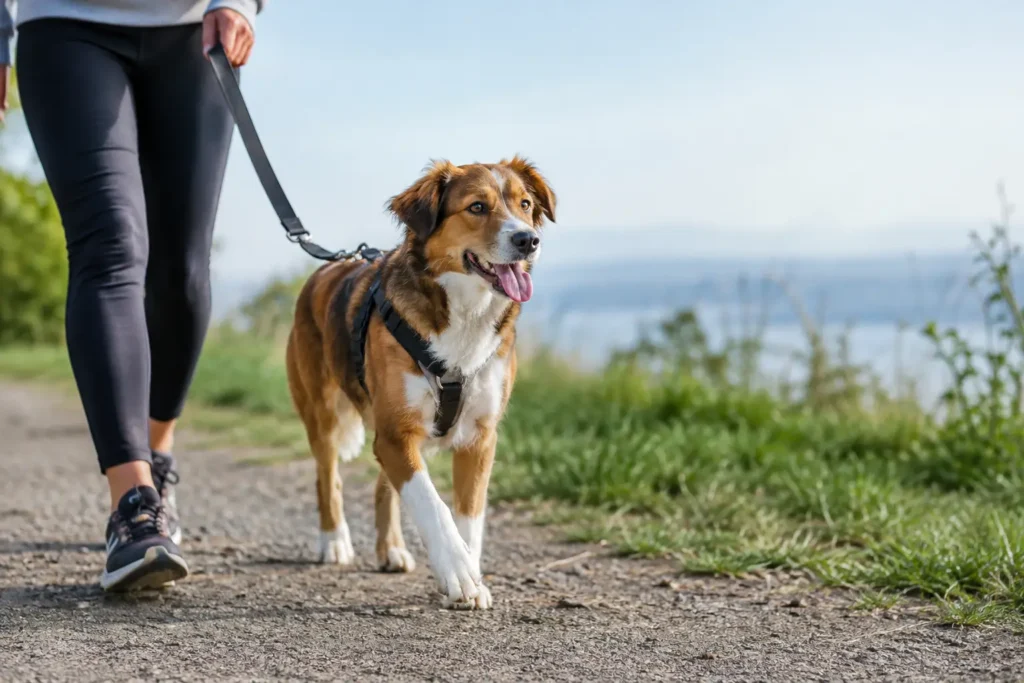
Equipment cannot create confidence on its own, but it can make training safer and clearer. A well-fitted harness that does not restrict shoulder movement is often a comfortable choice for dogs who pull or startle. For dogs who can back out of gear when frightened, a secure, properly fitted option is essential.
Avoid relying on retractable leashes near traffic. They can give a dog too much access to the curb, a bicycle lane, or another dog before you can respond. A standard leash gives you more control and helps your dog learn a consistent walking distance.
The best setup depends on your dog’s size, strength, health, and behavior. A tiny dog who freezes near trucks may need a different handling plan than a powerful adolescent dog who lunges toward moving vehicles. If you are unsure, a one-on-one assessment is far more useful than copying a setup from another dog owner.
Turn Traffic Into a Cue for Good Things
When used thoughtfully, treats can change how a dog feels about traffic. This is not bribery. It is teaching your dog that a hard moment predicts something safe and positive.
Start with the sounds or sights that are challenging but still manageable. A distant truck passes, and chicken appears. A skateboard rolls by across the street, and your dog gets a favorite reward for looking back at you. Over time, many dogs begin to hear or see the trigger and turn toward their person instead of escalating.
Keep your delivery calm. Excited chatter can add energy to an already stimulating moment. A quiet “good” and a quick reward often work better than repeated commands.
If your dog will not take food, do not force the issue. It may mean they are too worried to eat, or it may simply mean sniffing and moving away is more rewarding at that moment. Adjust the environment first.
Know When to Keep Walking and When to Retreat
Not every hesitation needs a full training session. A dog may stop to evaluate a loud vehicle, then decide they are okay. Give them a second when it is safe to do so. Rushing a dog through every concern can teach them that you do not listen.
At the same time, avoid allowing a fearful dog to rehearse panicked pulling or repeated street crossings in search of an escape. If they cannot recover, calmly turn toward a quieter route. Your job is to make good decisions before the walk becomes too hard.
This is where consistent handling matters. Different walkers using completely different rules can leave a dog uncertain. Clear leash communication, familiar cues, and thoughtful routes give them a dependable framework.
A Gradual Plan for Busy Manhattan Walks
For many dogs, a simple progression works best. Begin with quieter residential blocks and short exposure to traffic from a comfortable distance. Add one slightly busier corner once your dog is handling the first level well. Then practice during different times of day, including more active periods, while keeping the overall walk achievable.
Do not increase distance, noise, crowds, and speed all at once. Change one variable at a time. A dog may be comfortable near cars but not near buses, or fine with buses until a crowd gathers at the stop. These details are useful information, not bad behavior.
At Pet Love NYC, individualized walks and leash training are designed around those details. One-on-one attention allows a handler to notice whether a dog needs a little more distance, a slower route, an intersection refresher, or a confidence-building win before heading home.
When Extra Support Makes Sense
If your dog’s fear is intense, getting worse, or creating safety risks, professional guidance can make a meaningful difference. Dogs who bolt, redirect onto the leash, panic at street noise, or cannot leave the building comfortably need a careful plan, not more pressure.
A qualified trainer can observe the specific moments that trigger your dog and help you practice safe responses. Your veterinarian should also be involved if fear appears suddenly or seems out of character, since pain, hearing changes, and other medical issues can affect behavior.
Traffic confidence is built one calm choice at a time: a soft leash at the curb, a check-in after a siren, a quiet block chosen because your dog needed it. Those small moments teach your dog that, even on the busiest Manhattan sidewalk, they have someone paying attention.