


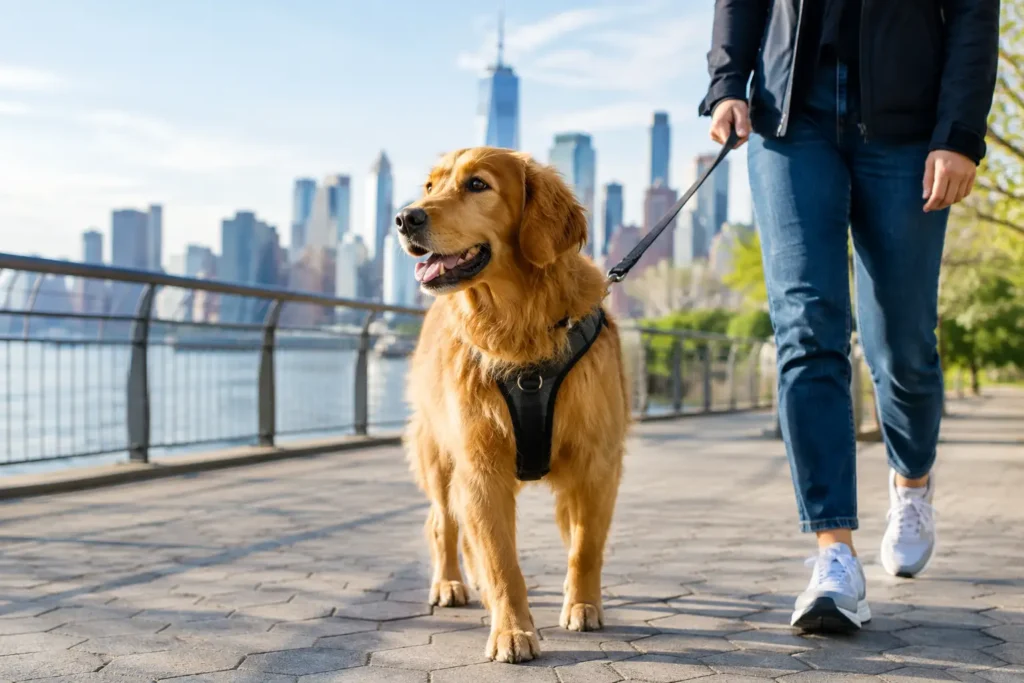
The curb is crowded, a delivery bike cuts close, and your dog suddenly stops sniffing. Their tail lowers, their body leans back, and they turn their head away from the approaching noise. That moment says far more than a bark ever could. This guide to canine body language will help you recognize what your dog is communicating, especially when Manhattan sidewalks give them a lot to process at once.
Dogs use their whole bodies to express comfort, curiosity, excitement, uncertainty, and fear. Reading those signals does not mean guessing your dog’s thoughts. It means noticing patterns early enough to respond with patience, space, and safe handling.
Why body language matters on city walks
A dog can enjoy a walk and still find parts of it overwhelming. Sirens, skateboards, construction, crowded elevators, other dogs, food scraps, and fast-moving people create a constant stream of information. A dog who looks fine from a distance may be working very hard to cope.
When an owner or walker recognizes stress before it becomes pulling, barking, lunging, or freezing, they can make a better choice. That may mean crossing the street, shortening the route, pausing in a quieter spot, or giving the dog time to observe from a comfortable distance. This is not about avoiding every challenge. It is about building confidence without pushing a dog past what they can handle.
Body language also helps us recognize the good moments. A relaxed dog who sniffs, moves at an easy pace, checks in with their handler, and recovers quickly after a surprise is telling us the walk is meeting their needs.
A guide to canine body language: read the whole dog
No single signal tells the complete story. A wagging tail, for example, can mean friendly excitement, alertness, frustration, or tension depending on its height, speed, and the rest of the dog’s posture. Context matters just as much as the cue itself.
Relaxed and comfortable
A comfortable dog generally has a loose, wiggly body. Their mouth may be softly open, their ears rest in a natural position, and their tail moves freely rather than stiffly. They may sniff the ground, look around without locking onto every movement, and choose to approach or move away at an unhurried pace.
On a busy walk, relaxation does not require a dog to ignore the city. Looking at a passing bus or another dog is normal. What matters is whether they can look, process the moment, and return their attention to walking or checking in with their handler.
Curious and engaged
Curiosity often looks like a forward but not rigid posture. Your dog may lift their ears, pause to look, sniff with interest, or gently lean toward a new scent. Their movements are usually fluid, and they can disengage when you invite them to continue.
Letting a dog sniff is not wasted walk time. For many dogs, scent work is mentally enriching and can make a 30-minute walk feel more satisfying than rushing through the same blocks. The trade-off is safety: near intersections, building entrances, or discarded food, a shorter leash and clear direction are often necessary.
Stressed, worried, or overwhelmed
Stress signals can be subtle. Watch for lip licking when no food is present, yawning outside of nap time, sudden scratching, turning the head away, showing the whites of the eyes, or lowering the body. Some dogs become very still. Others speed up, pull, whine, or scan constantly.
A tucked tail is a common sign of concern, but not every worried dog tucks their tail. Some hold it high and stiff. Likewise, a dog who barks at another dog may not be eager to say hello. They may be asking for more distance.
If your dog begins to freeze at an intersection, do not drag them forward. First, look for the trigger: a loud truck, a crowd, a dog across the street, or a slippery grate. Create space if you can, speak calmly, and give them a moment to regroup. Repeated freezing or fear on walks is worth discussing with a qualified trainer and your veterinarian, particularly if the behavior is new or escalating.
Overexcited and frustrated
High energy is not always happiness. A dog who pulls hard toward every person, dog, pigeon, or smell may be excited, but they may also be frustrated by restraint and overstimulation. Look for a tense leash, hard staring, rapid pacing, vocalizing, and difficulty responding to familiar cues.
The answer is rarely to correct harder or move faster. A structured walk with enough room for decompression, predictable expectations, and rewards for checking in can help a dog practice calmer choices. For some dogs, passing another dog across the street is a success. For others, a simple pause at a distance is the right first step. Progress depends on the individual dog in front of you.
Pay attention to eyes, ears, tail, and weight
Your dog’s face and posture work together like a sentence. Soft eyes and a loose body usually suggest ease. Wide eyes, a furrowed brow, or an intense, unblinking stare suggest that something has captured their attention more seriously.
Ears may point forward when a dog is interested, swivel as they track sounds, or pin back when they feel uncertain. But ear shape varies by breed and individual, so compare your dog to their own normal resting position rather than relying on a universal rule.
Tail position is equally personal. A naturally curled or short tail gives less information than a long tail, and some dogs normally carry their tails high. Notice changes. A tail that suddenly becomes stiff, low, or tightly tucked can be meaningful, especially alongside a change in breathing, pace, or focus.
Weight distribution is one of the most useful signals on a walk. A dog leaning forward may be preparing to investigate or react. A dog leaning away is often asking for distance. If their feet stop moving while their body stays tense, treat that pause as communication, not stubbornness.
How to respond without adding pressure
The most helpful response to concerning body language is usually calm and practical. Give your dog more space from the trigger, keep the leash secure without making it painfully tight, and avoid forcing greetings with people or dogs. Your dog does not need to greet everyone to be well socialized.
Use a warm voice and reward the behaviors you want to see more of: looking back at you, walking with a loose leash, moving away from a distraction, or settling after a loud sound. If your dog cannot take a treat, respond to their name, or move with you, the situation may be too intense. Increase distance and lower the demand.
Consistency matters when more than one person walks your dog. Shared cues, predictable boundaries, and clear updates help a dog feel secure. At Pet Love NYC, individualized walks make it easier to notice a dog’s usual rhythm and flag meaningful changes, from a new sensitivity around traffic to a cheerful improvement in leash manners.
Know when behavior may be a health concern
Not every posture change is emotional. A dog who suddenly lags behind, resists stairs, pants heavily in mild weather, repeatedly shakes their head, or reacts when a harness is put on may be uncomfortable or in pain. Irritability, hiding, or a sharp reaction to touch can also be signs that a veterinary check is needed.
Trust what you know about your dog. You spend time with them, and a good walker can add useful observations from daily routines. Small changes are easier to investigate early than after they become a larger problem.
The goal is not to interpret every ear flick perfectly. It is to become the person your dog can count on: someone who notices, listens, and makes the next block feel manageable. On a busy Manhattan sidewalk, that kind of attention is one of the greatest gifts you can give them.