


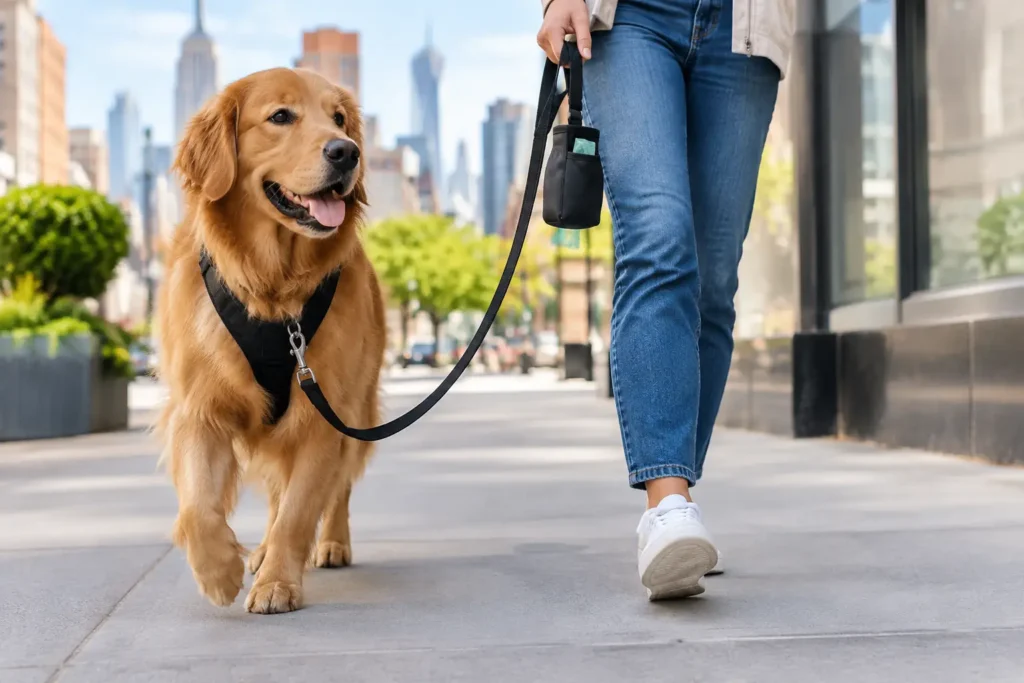
A Manhattan sidewalk can change in one second. A delivery cart rattles past, a cab horn sounds, another dog appears at the corner, and your pup catches the scent of a dropped bagel. The best leash tools for sidewalks do not replace training or your relationship with your dog, but they make it much easier to communicate clearly and keep everyone safe when the city gets busy.
For most dogs, the right setup is simple: a well-fitted walking harness, a fixed-length leash, and a few practical tools that support calm choices. The goal is not to restrain your dog through every block. It is to give them enough freedom to sniff and enjoy their walk while keeping them close enough for safe, consistent guidance.
1. A well-fitted front-clip harness
For many city dogs, a front-clip harness is the most useful starting point. The leash attaches at the chest rather than between the shoulders, which helps turn a pulling dog back toward their handler instead of allowing them to lean their full body weight into the walk.
This can be especially helpful for young dogs, enthusiastic greeters, and larger dogs who pull toward pigeons, food carts, or other dogs. It is not a shortcut for leash training, but it gives you more control while you teach your dog that a loose leash is what moves the walk forward.
Fit matters just as much as style. A harness should sit securely without rubbing behind the front legs or restricting shoulder movement. You should be able to slide two fingers beneath the straps, but your dog should not be able to back out of it. Check the fit often, especially for puppies and dogs whose weight has changed.
Some dogs find a front attachment frustrating at first, while others walk beautifully with it. If your dog freezes, twists, or seems uncomfortable, try adjusting the fit or ask a qualified trainer to assess the setup rather than assuming they need a stronger tool.
2. A fixed 4- to 6-foot leash
A standard, fixed-length leash is one of the best leash tools for sidewalks because it is predictable. You always know how much space your dog has, and your dog receives the same clear boundary block after block.
A 6-foot leash works well on quieter streets and gives most dogs room to sniff. On packed sidewalks, at intersections, or near construction, a 4-foot leash can provide a little more control. Many Manhattan dog owners like a 6-foot leash with a built-in traffic handle near the clip, which offers both options without needing to switch equipment mid-walk.
Look for durable nylon, biothane, or leather with secure hardware. Biothane is particularly practical for city life because it wipes clean after rainy sidewalks and is less likely to hold onto odor than fabric. Leather can feel wonderful in the hand, but it needs care and should be replaced if it becomes cracked or weakened.
Avoid retractable leashes for crowded urban walks. They can put too much distance between you and your dog at the exact moment you need close control. Thin cords are also difficult to grab safely, and the brake mechanism can fail or be used too late near traffic, cyclists, or another dog.
3. A traffic handle for close-control moments
A traffic handle is a short second handle positioned close to your dog’s harness or collar clip. It is not meant for an entire walk. It is there for the high-attention moments: crossing an avenue, passing a narrow sidewalk, waiting at a curb, entering an elevator, or moving by an unfamiliar dog.
The best traffic handles give you a quick way to bring your dog close without wrapping the leash around your hand or shortening it in a rush. That matters when a delivery bike comes around a corner or a construction barrier suddenly narrows your path.
Use this tool with care. Holding a dog close for too long can make them feel trapped, especially if another dog is approaching. Create distance whenever you can. A traffic handle is most helpful as a brief safety measure, followed by a return to a comfortable walking length once the situation has passed.
4. A secure treat pouch
Treats are not a bribe. Used thoughtfully, they are a way to tell your dog, “Yes, that was the choice I wanted.” On city sidewalks, a treat pouch lets you reward the behaviors that make walks safer and more enjoyable: checking in with you, waiting at curbs, passing a distraction without lunging, and turning away from something overwhelming.
Choose a pouch that opens easily with one hand and closes securely. You do not want treats spilling onto the sidewalk while you are managing a busy intersection. Soft, small treats work best because your dog can eat them quickly and continue moving without a long stop.
Timing is more valuable than quantity. Reward your dog just after they look at a skateboard and then look back at you, or when they pause at the curb without being pulled into position. Over time, these little moments build a dog who notices the city but does not need to react to every part of it.
5. A clicker or marker word
A clicker can be useful for dogs learning leash manners, particularly when you are working on specific skills at home or on a quieter block. The click marks the exact moment your dog makes the right choice, followed by a treat. For example, click when the leash goes slack or when your dog chooses to walk beside you past a distraction.
Not every owner needs a physical clicker. A consistent marker word such as “yes” can work just as well if you use it clearly and always follow it with a reward during training. The advantage of a marker is precision. It helps your dog understand which action earned the good thing.
On a bustling sidewalk, a marker word is often more convenient than juggling a clicker, leash, treat pouch, phone, and keys. The tool should make your handling calmer, not more complicated.
6. A backup safety connection
Dogs who are fearful, newly adopted, strong, or skilled at slipping out of gear may benefit from a backup connection. This is usually a short safety strap that connects the harness to a properly fitted flat collar. If the harness comes loose, your dog is still attached to you.
This extra layer of security can bring real peace of mind in New York, where an escaped dog can quickly reach a street, subway entrance, or crowd. It is particularly worthwhile during a transition to new equipment or while you are still learning what makes your dog uncomfortable.
The backup should be short enough that it does not tangle around your dog’s legs. It should never be used with an improperly fitted collar or as an excuse to rely on worn-out equipment. Check all clips, rings, stitching, and leash attachments before heading out.
7. Comfortable walking gear for the human end of the leash
The person holding the leash needs the right tools too. A hands-free waist belt can be useful for steady, trained dogs when you need to carry coffee, push a stroller, or manage weather gear. However, it is not the best choice for a dog who lunges or pulls hard. A sudden force at your waist can affect your balance and make it harder to respond quickly.
In cold or rainy weather, grippy gloves can make a meaningful difference. So can shoes with reliable traction. Sidewalk safety is shared safety: if you lose your footing on a wet curb, even excellent dog gear cannot do its job.
What not to rely on for city walking
Tools designed to create discomfort, including prong collars, choke chains, and harsh slip devices, can suppress behavior without teaching your dog what to do instead. They can also make a dog associate pain or pressure with passing dogs, strangers, bicycles, or traffic. For a dog already worried by the city, that association may intensify reactivity.
A head halter can be helpful for some strong pullers when introduced gradually and used correctly, but it is not right for every dog. Because pressure is applied around the head, sudden pulling can be uncomfortable and potentially risky. It should be paired with patient conditioning, not forced onto a dog for a rushed walk.
The safest tool is the one your dog can wear comfortably, you can handle confidently, and both of you can use consistently. At Pet Love NYC, we see the biggest changes when equipment and training work together: clear cues, thoughtful rewards, safe distance from triggers, and walks tailored to the dog in front of us.
Your dog does not need to walk like a robot through Manhattan. They need a handler who can keep them safe, notice their feelings, and guide them with calm consistency. Start with one reliable setup, practice on a quieter block, and let every successful sidewalk moment become the foundation for the next one.