


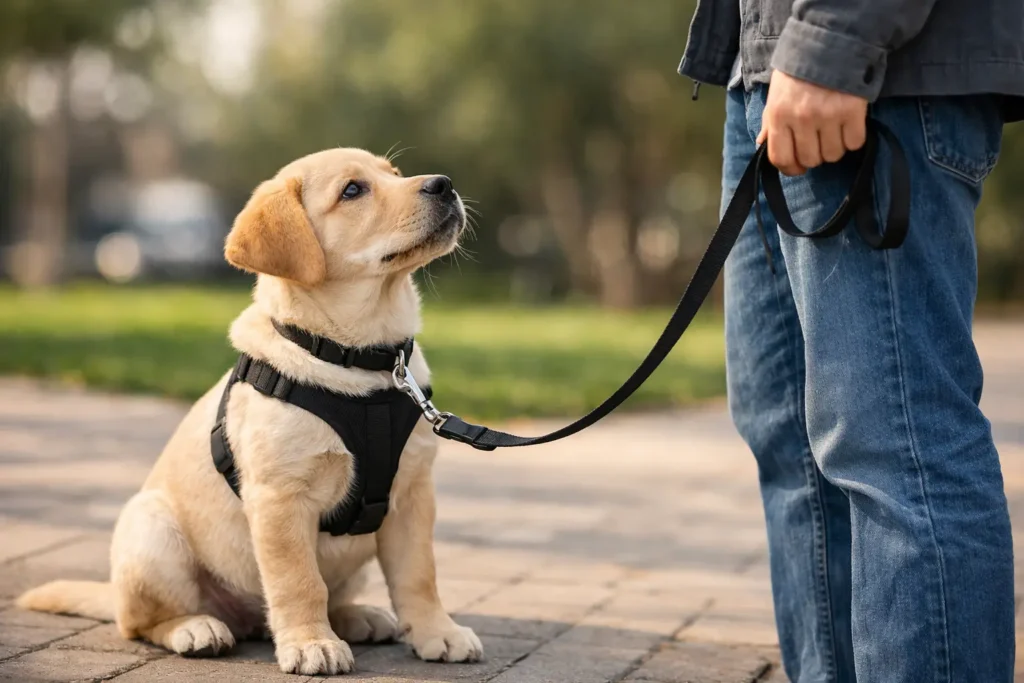
The first time your puppy plants all four paws on a Manhattan sidewalk while a bus hisses past, a pigeon flutters overhead, and three people step around you with coffee in hand, leash walking stops feeling simple. Puppy leash manners training is not just about teaching a dog to walk nicely. In a city, it is about safety, communication, and helping a young dog feel steady in a fast-moving world.
For many puppy owners, the frustration starts early. One day your puppy forges ahead and pulls toward every smell. The next day they freeze at the curb, mouth the leash, or zigzag so much that a short block feels like a full workout. None of that means you have a bad dog. It usually means you have a normal puppy trying to process too much at once.
What puppy leash manners training really means
Good leash manners are less about perfection and more about partnership. A puppy does not need to walk in a rigid heel on every outing to be successful. What most owners actually need is a dog that can move through the neighborhood without dragging them, panicking, or making every corner unpredictable.
That matters even more in an urban setting. Sidewalk traffic, scooters, delivery carts, construction sounds, food scraps, and close passes from strangers all create pressure on a young dog. When a puppy pulls, lunges, or stalls, it is often a response to excitement, uncertainty, or overstimulation rather than stubbornness.
A strong training plan teaches your puppy how to stay connected to you, how to slow down, and how to recover quickly after distractions. It also teaches you how to read your dog before a small issue becomes a tug-of-war in the middle of an intersection.
Why puppies struggle on leash in the city
Puppies are learning several hard things at the same time. They are figuring out what the leash feels like, what the outside world sounds like, and what you want from them while their attention span is still very short. Add New York energy to that mix and even a confident puppy can get overwhelmed.
Some puppies pull because they are eager and social. Some lag behind because the environment feels too big. Others switch between both. It depends on the dog, the block, the time of day, and even how much sleep they got beforehand.
This is why rushed, one-size-fits-all walking often backfires. A puppy that needs reassurance can look disobedient. A puppy that needs clearer structure can look wild. Good leash training works best when the pace, route, and expectations fit the individual dog.
Start with calm before you start with movement
One of the most common mistakes owners make is beginning the walk when the puppy is already overexcited. If the leash comes out and your dog starts spinning, jumping, or biting at your hands, the training has started before the front door opens.
A calmer exit sets the tone for everything that follows. Pause before clipping the leash on. Wait for four paws on the floor. Keep your voice steady. If your puppy surges the moment the door opens, stop and reset. That short moment of patience teaches more than hurrying out and spending the next ten minutes trying to regain control.
For city puppies, the doorway, elevator, lobby, and building entrance are part of the training session. These transition points often bring the biggest spikes in excitement. Practicing calm there helps your puppy carry that composure onto the sidewalk.
How to teach loose-leash walking without a battle
The goal is simple: your puppy learns that staying near you makes the walk continue, while pulling does not. The method should be clear and consistent, not harsh.
Start in lower-distraction areas whenever possible. A quiet side street, hallway, courtyard, or less busy time of day gives your puppy a real chance to succeed. Reward attention to you, even if it is brief. A quick check-in, a few steps on a loose leash, or choosing your side over a distraction is worth noticing.
When the leash tightens, avoid turning it into a pulling contest. Stop, soften the moment, and encourage your puppy back into position before moving again. Some dogs do best with frequent praise and food rewards. Others respond more to pace changes and clear repetition. It depends on motivation, age, and confidence.
Keep your expectations realistic. A young puppy may only manage a few good steps at a time in a stimulating environment. That is still progress. You are building a pattern, not demanding finished behavior overnight.
Puppy leash manners training at intersections
Intersections deserve special attention because they combine movement, noise, and risk. A puppy that pulls into the curb lane, darts forward on a light change, or panics at turning vehicles can put both of you in a difficult position quickly.
Teach a predictable routine at every corner. Slow down before the curb, ask for a pause, and reward stillness or attention. The cue can be simple, but the repetition matters. Over time, your puppy learns that corners are places to check in rather than launch forward.
This is one area where consistency from every handler matters a lot. If one person allows rushing and another requires calm, puppies get mixed messages. Clear, repeatable handling makes city walking safer and less stressful for everyone.
Managing distractions instead of fighting them
You do not need your puppy to ignore the entire city. You need them to recover from distractions and stay responsive. That is a more practical goal, and for most urban owners, it is the one that truly improves daily life.
Start by noticing what pulls your puppy out of focus. For some dogs it is other dogs. For others it is skateboard sounds, food on the sidewalk, or people wanting to say hello. Once you know the triggers, you can work at enough distance that your puppy stays under threshold and can still respond.
If your puppy loses control the moment a trigger appears, the setup is probably too hard. Move farther away, shorten the session, or choose a calmer route. Training is not less effective because it looks easier. In fact, easier practice is often what allows faster progress.
Equipment helps, but it does not replace training
Owners often ask which leash, harness, or collar will fix pulling. The honest answer is that equipment can support training, but it cannot teach judgment, emotional regulation, or communication by itself.
A well-fitted harness can improve comfort and handling. A standard leash usually gives better feedback than retractable options in a busy city. Beyond that, success comes from timing, consistency, and making sure the puppy is not constantly pushed past their limits.
If a puppy is regularly choking, twisting, backing out of gear, or getting more frantic during walks, that is worth addressing right away. The right setup should help your dog feel secure while you build better habits.
When progress feels slow
Leash manners rarely improve in a straight line. Puppies go through fear periods, growth spurts, and phases where the outside world suddenly seems much more interesting than you. A dog that walked nicely last week may struggle this week. That can be normal.
What matters is the overall direction. Are recoveries getting faster? Is your puppy checking in more often? Are exits from the building calmer than they were before? Those smaller markers usually show real progress before a walk looks polished from start to finish.
If things are getting worse, look at the routine. Walks may be too long, too stimulating, or too inconsistent. Some puppies benefit from shorter, more focused outings with a clear purpose instead of one long walk that leaves them overtired and over aroused.
Why individualized support makes such a difference
Puppy leash manners training works best when someone pays close attention to the dog in front of them. That is especially true in Manhattan, where every route presents different challenges and every puppy responds differently to noise, traffic, dogs, and density.
A puppy that needs confidence-building should not be handled like a puppy that simply needs cleaner boundaries. A dog learning to move calmly past storefronts may need a different strategy than one struggling with intersection behavior or leash biting in the lobby. Individualized handling helps the dog learn faster because the training matches the actual problem.
That is one reason many owners choose one-on-one support instead of crowded group walking. Personalized walks create room for repetition, observation, and safer decision-making. At Pet Love NYC, that kind of focused attention is at the heart of how leash skills are built – with clear communication, careful handling, and updates that help owners stay connected to the process.
A puppy does not need a perfect walk to have a good one. If your dog is learning to check in, move with you, and feel a little more settled block by block, that is meaningful progress worth building on.