


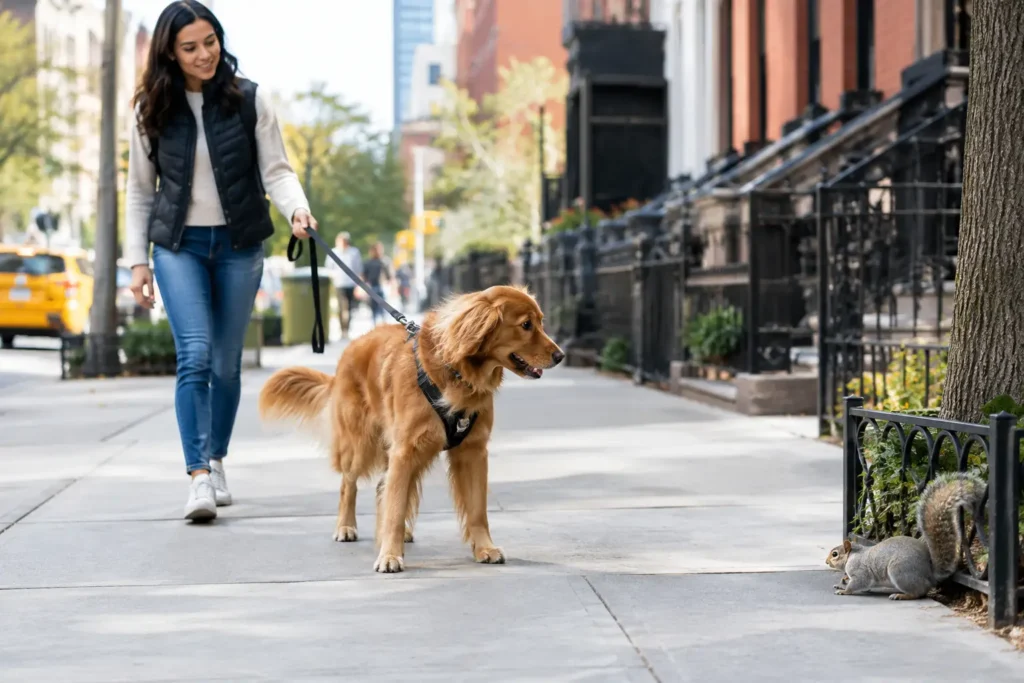
A dropped chicken bone outside the corner deli. A skateboard rattling up behind you. A squirrel making a fearless run across the park path. Manhattan dogs encounter a lot before breakfast, and learning to manage dog sidewalk distractions can make every walk feel safer, calmer, and more enjoyable for both of you.
Distraction is not disobedience. Most dogs are responding normally to a very stimulating environment. The goal is not to make your dog ignore the world completely. It is to teach them that they can notice something exciting, surprising, or worrying and still reconnect with you on the leash.
Start With the Right Expectation
A busy sidewalk asks a great deal of a dog. There are tight spaces, moving feet, food smells, delivery carts, other dogs, sirens, construction noise, and people who may reach toward a cute pup without asking. Puppies are learning what the city means. High-energy dogs may see every passing object as an invitation. Sensitive dogs may become overwhelmed long before they show it.
Your first job is to notice your dog’s threshold. This is the point where they can still see or hear a distraction and respond to you. Below threshold, your dog may look at another dog but can take a treat, turn with you, or continue walking. Over threshold, they may pull, freeze, bark, lunge, spin, or stop accepting food.
Training works best below threshold. If your dog is already at the end of the leash, shouting or repeatedly asking for a cue usually will not help. Create more distance first, then give them a simple, familiar task.
Build Connection Before the Busy Block
The most useful leash skills are practiced in low-pressure places before you need them beside a crowded avenue. Start in your lobby, hallway, building entrance, or a quiet stretch of sidewalk. Bring small, high-value treats that your dog can eat quickly, and keep the leash short enough for safety without holding it tight.
Practice your dog’s name, a cheerful “let’s go,” and a hand target or “touch” cue. When your dog looks at you after hearing their name, reward them right away. When they turn with you, reward again. These small moments teach your dog that checking in with you pays well.
A loose leash is also easier to maintain when you reward the position you want. Offer a treat near your leg when your dog is walking beside you with a little slack in the leash. You do not need military-style heel work for an enjoyable city walk. You do need enough shared attention that you can guide your dog away from a hazard without a tug-of-war.
How to Manage Dog Sidewalk Distractions in Real Time
On city walks, early action matters more than perfect timing. Scan ahead instead of waiting for your dog to spot the trigger first. If you see an off-leash-looking dog at a distance, a cluster of scooters, or a pile of food near the curb, make a calm plan before the leash gets tight.
Cross the street when it is safe. Step into a building entrance to let a crowd pass. Turn down a quieter block. Move behind a parked car only if it gives you a safe, legal buffer from the sidewalk traffic. Distance is not avoidance or failure. It is a practical training tool that gives your dog room to think.
As you pass a distraction, use one clear cue your dog knows. A warm “this way” followed by a turn is often more useful than a stream of instructions. Reward your dog for looking at you, moving with you, or calmly noticing the trigger and choosing not to react. Even two seconds of composure deserve recognition.
If your dog does react, stay matter-of-fact. Secure your grip, create distance, and keep your voice low. Do not punish barking, lunging, or fearful behavior in the moment. Corrections can make a dog associate other dogs, strangers, or traffic with an unpleasant experience, which may increase the reaction over time. Once your dog has settled, return to an easier environment or continue the walk at a calmer pace.
Match Your Strategy to the Distraction
Not every distraction should be handled the same way. A dog who pulls toward pigeons needs a different plan than a dog who is frightened by buses.
For food scraps and sidewalk treasures, management comes first. Keep your dog on the inside of the sidewalk when possible, away from curbside debris. Practice a reliable “leave it” with boring items at home, then build up gradually outside. Do not test the cue with a dangerous item before it is ready. If you spot something unsafe, calmly guide your dog away and reward them for following.
For other dogs, avoid forced greetings. A quick hello may look friendly, but it can create frustration for dogs who expect to greet every dog they see. It can also put both dogs in an awkward, confined position. Let your dog observe from a comfortable distance, reward calm behavior, and keep moving unless both handlers clearly want a brief, appropriate greeting.
For people, especially children or enthusiastic strangers, advocate for your dog. A simple “We’re training, thank you” protects your dog’s space without needing a long explanation. Dogs do not owe anyone a greeting. This is especially true for puppies, shy dogs, seniors, and dogs recovering from difficult experiences.
For traffic and construction, choose your route with your dog’s comfort in mind. Some dogs can gradually learn to tolerate louder blocks with treats and patient exposure. Others will do better with quieter side streets and park paths. The trade-off is simple: exposure can build confidence only when it is controlled enough that your dog remains able to cope.
Give Your Dog a Job at Intersections
Intersections combine noise, movement, and waiting, which is why they often bring out pulling and excitement. A consistent routine can make them much easier.
As you approach the curb, slow down before your dog reaches the end of the leash. Ask for a brief pause, eye contact, or hand target while you wait for the signal. Reward the behavior you want, then use the same release phrase each time you cross. Your dog begins to learn that stopping at the curb and moving forward with you are predictable parts of the walk.
Keep the crossing focused. This is not the moment to let your dog zigzag, sniff food near the gutter, or greet another dog. Once you reach the other side, offer a calm sniff break if the area is clear. Sniffing is not a distraction to eliminate. It is valuable enrichment, and a dog who gets appropriate chances to sniff is often more settled between busy moments.
Avoid the Habits That Make Pulling Worse
Many well-meaning owners accidentally reward the behavior they want to change. If pulling gets a dog closer to a pigeon, another dog, or an interesting smell, pulling works from the dog’s point of view. Repeating “no” while continuing toward the exciting thing can also become background noise.
Instead, pause or change direction when the leash tightens, then resume forward movement when there is slack. Be realistic about the setting. Asking a young, energetic dog to walk perfectly through Times Square at rush hour may be too much for where they are in training. A shorter, more successful route is often better than a long walk filled with stress.
Equipment matters, but it is not a substitute for practice. A well-fitted harness and a standard leash generally give you more comfortable control than retractable leashes on crowded sidewalks. The best setup depends on your dog’s size, body shape, and behavior, so fit and handling should be checked carefully.
Consistency Makes City Walks Feel Safer
Dogs learn fastest when the people walking them use the same cues, boundaries, and rewards. If one person allows curbside scavenging, another insists on a tight heel, and a third lets the dog pull to every greeting, the rules become hard to understand.
A simple shared plan goes a long way: use the same turn cue, reward check-ins, skip on-leash greetings when needed, and give your dog space before they become overwhelmed. If a professional walker helps care for your dog, regular notes about triggers, successful routes, and progress can keep that plan consistent. At Pet Love NYC, individualized walks make it possible to pay close attention to those details rather than asking your dog to keep up with a pack.
For dogs who bark, lunge, panic, or cannot recover after seeing common triggers, personalized leash training support can help you identify the cause and make a safe plan. Some behavior needs more than extra exercise. It needs patient handling, clear communication, and gradual practice at the dog’s pace.
The next time a city block gets busy, aim for one small win: a glance back at you, a loose leash past a food cart, or a calm pause at the corner. Those are the moments that build a dog who can enjoy New York with confidence, one thoughtful walk at a time.